When evaluating real estate investments, home buyers and industry professionals often focus on the physical structure of a home: its square footage, the quality of its kitchen countertops, the layout of its master suite, or the age of its roof. However, a property does not exist in a vacuum. It is deeply connected to its surroundings.
In modern real estate markets, the neighborhood is just as important as the house itself. Well-chosen community amenities (المرافق المجتمعية) can transform a simple residential community into a highly desirable, premium enclave. These communal assets do more than make life more convenient; they act as powerful drivers of long-term property value and serve as major selling points when it is time to list a home on the market.
Whether you are looking to purchase a home in a premium master-planned development or evaluating the benefits of gated community amenities versus open neighborhood amenities, this guide analyzes how communal shared spaces affect real estate valuations, lifestyle quality, and long-term investment security.
1. The Real Estate Economics of Community Amenities
To understand why communal assets affect home values so significantly, we must look at the fundamental economics of real estate. Real estate values are driven by scarcity, utility, and desirability.
When developers build a neighborhood, they do not just sell houses; they sell a lifestyle. The shared infrastructure surrounding those homes is what creates that lifestyle.
The Capitalization of Shared Amenities
In financial terms, economists refer to the rise in real estate prices driven by surrounding infrastructure as “amenity capitalization.” This means the value of shared neighborhood features (such as a beautiful public park, a secure gated entry, or an elite fitness center) is directly incorporated into the market price of the nearby homes.
When an area offers high-quality shared spaces, more buyers compete for a limited number of homes. This increased demand drives up prices, ensuring that homes in amenity-rich communities tend to maintain their value better during economic downturns and appreciate faster during market climbs.
2. Direct Value vs. Indirect Value: A Core Distinction
Not all amenities are valued the same way by the market. To make an informed investment, you must understand the difference between direct and indirect value drivers.
Direct Value Drivers
These are features that have a measurable, positive effect on a home’s financial appraisal. Appraisers can look at comparable sales in the area to put a clear dollar value on these features.
-
Examples: 24/7 active security systems, private golf courses, community pools, and gated entries.
-
Impact: They directly increase the baseline valuation of homes within the community, often justifying higher homeowners association (HOA) fees.
Indirect Value Drivers
These features might not add a specific, easily calculated dollar amount to an appraisal report, but they dramatically reduce a home’s “days on market” (DOM) by making the property far more appealing to prospective buyers.
-
Examples: Walking trails, community gardens, dog parks, and shared workspaces.
-
Impact: They widen the buyer pool, making the home easier to sell quickly because they enhance the overall lifestyle and sense of community.
3. High-Value Amenities: Security, Health, and Education
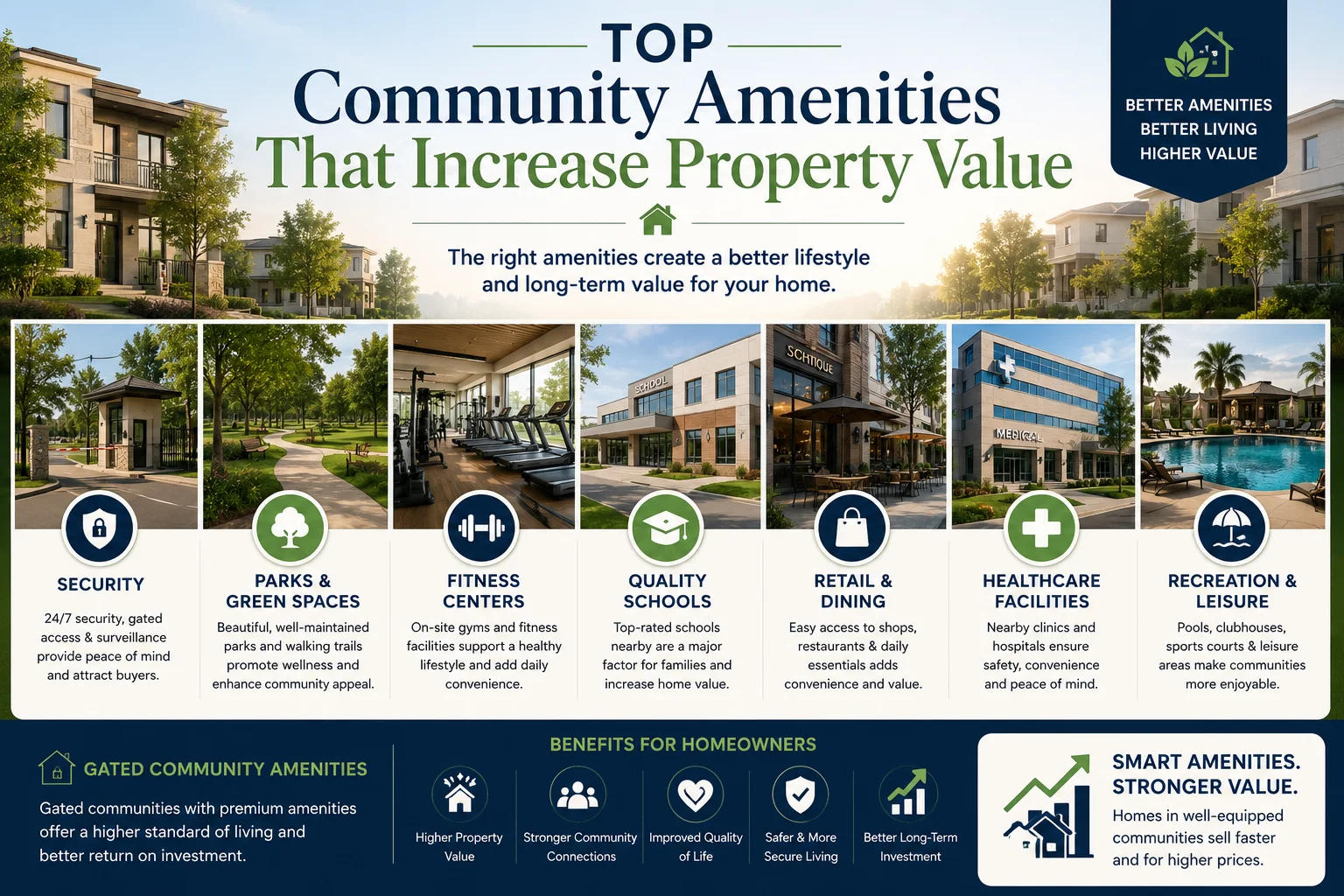
When analyzing which shared features add the most long-term value, three main pillars stand out: Security, Health/Wellness, and Education. These represent fundamental human needs, making them highly resilient to shifting design trends.
A. Security: The Foundation of Gated Communities
Security is a top priority for home buyers, particularly families and high-net-worth individuals. A neighborhood that feels safe will always command a premium over one with security concerns.
The Premium of Gated Community Amenities
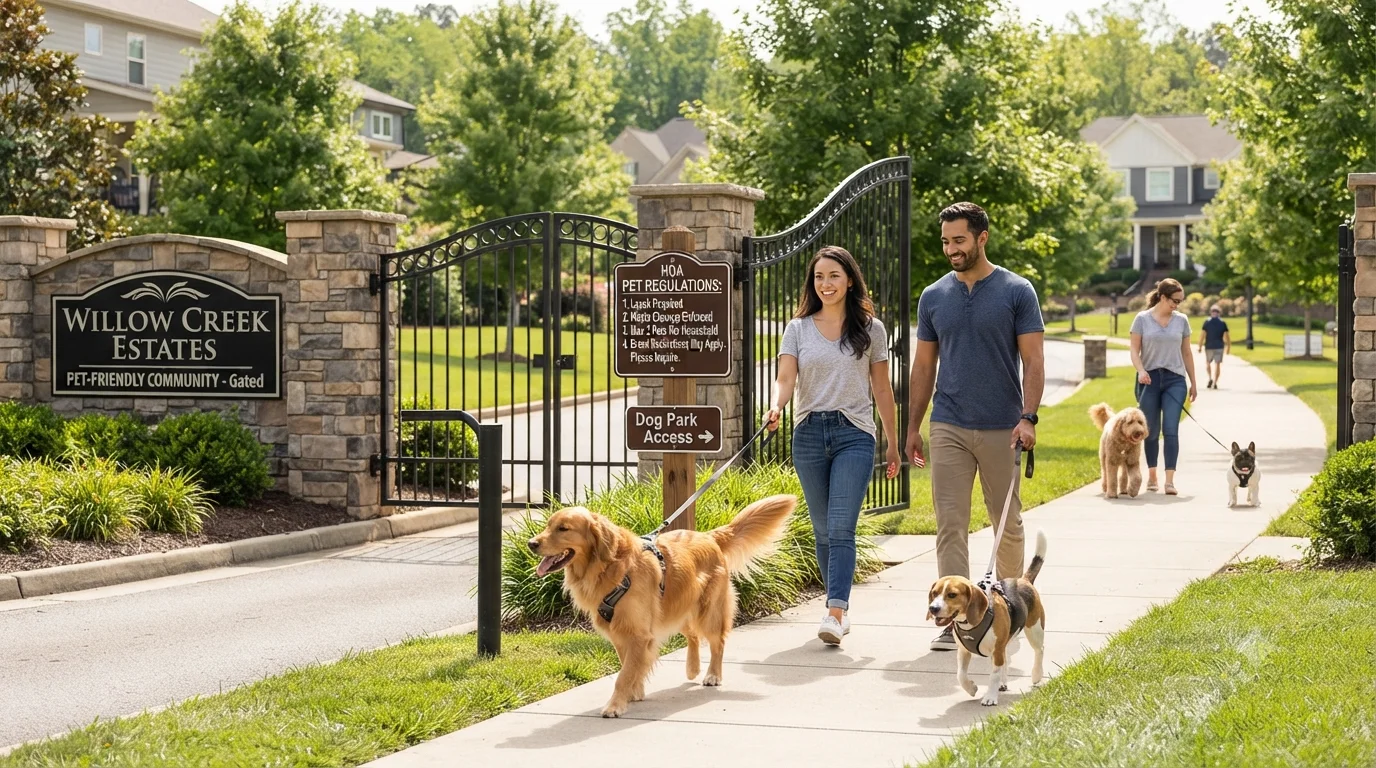
Properties located in neighborhoods with gated entryways and active security measures consistently command higher prices than identical homes in open neighborhoods.
-
Controlled Access: Gated entries, automatic license plate readers, and security guards keep unauthorized traffic out of the neighborhood. This keeps the streets quieter, safer for children playing outside, and less prone to opportunistic crime.
-
Monitored Security Networks: Modern gated communities often feature integrated CCTV networks and regular security patrols. This active monitoring provides peace of mind that buyers are willing to pay a premium for.
B. Health & Wellness: Modern Fitness and Green Spaces
The modern home buyer is highly focused on health and wellness. Neighborhoods that make it easy to maintain an active lifestyle without driving to a separate facility see strong demand.
Fully Equipped Fitness Centers
A basic room with a couple of outdated treadmills is no longer enough. Modern master-planned developments now feature state-of-the-art fitness centers that rival commercial gyms.
-
High-End Equipment: Premium cardio machines, free weight zones, and dedicated functional training spaces (such as turf areas for cross-training).
-
Dedicated Wellness Studios: Dedicated spaces for yoga, Pilates, and spin classes—often hosting community-led group fitness sessions.
Swimming Pools and Aquatic Complexes
A community pool remains one of the most requested features in family-oriented developments.
-
Resort-Style Pools: Large, heated pools with cabanas, lounge chairs, and dedicated lap lanes for exercise.
-
Splash Pads and Kids’ Zones: Safe, shallow water play areas that keep children entertained and safely separated from lap swimmers.
C. Education: The Proximity of Quality Schools
For buyers with children, the quality and accessibility of local schools is often the single most important factor in their home search.
-
Walkable Schools: Neighborhoods with top-tier public, private, or charter schools located within walking or biking distance enjoy excellent long-term price stability.
-
Reduced Commutes: Parents are willing to pay a significant premium to avoid long school-run traffic, making on-site or adjacent educational facilities a massive asset for home values.
4. Lifestyle and Leisure Amenities: Parks, Retail, and Recreation
While safety and education form the foundation of a solid community, lifestyle and leisure amenities are what truly make a neighborhood feel like home. These features create opportunities for connection, play, and relaxation.
A. Parks, Greenways, and Open Spaces
- As urban and suburban areas become more densely populated, private green space has become highly prized. Shared parks and trails allow residents to connect with nature right outside their front door.
-
Paved Walking and Biking Trails: Extensive trail networks that connect different parts of the development encourage walking and biking, reducing car use within the neighborhood.
-
Pocket Parks: Small, manicured green spaces scattered throughout the neighborhood ensure that every home is only a short walk from a patch of grass and trees.
-
Community Dog Parks: Fenced-in play areas with separate zones for large and small dogs have become one of the fastest-growing and most requested community features.
B. Retail and Commercial Convenience
The desire for “15-minute neighborhoods”—where daily necessities can be reached within a 15-minute walk—has transformed modern residential master plans.
-
On-Site Retail and Cafes: Having a local coffee shop, grocery store, pharmacy, or dry cleaner within the community boundary adds immense convenience.
-
Co-Working Spaces: With the rise of remote and hybrid work, community clubhouses that offer professional workspaces, high-speed Wi-Fi, and private meeting rooms are highly attractive to modern professionals.
C. Recreation: Sports Courts and Social Hubs
Recreational facilities encourage active lifestyles and help build a strong, connected neighborhood culture.
-
Tennis and Pickleball Courts: Pickleball’s rapid growth has made dedicated courts highly sought-after, often yielding a high return on investment for communities due to their compact footprint.
-
The Neighborhood Clubhouse: A multi-functional hub where residents can host private events, attend community holiday parties, or relax in shared lounge areas.
5. Comparative Value: Which Amenities Add the Most to Your Home’s Value?
To help you understand which features provide the best return on investment, we have compiled a detailed breakdown of common community assets, their impact on home values, and how appealing they are to buyers.
| Amenity Category | Impact on Property Value | Key Buyer Demographic | Maintenance Cost to HOA |
| Gated Entry & 24/7 Active Security | Very High (Direct Premium) | Families, Retirees, Luxury Buyers | High (Staffing & Tech) |
| Paved Walking & Biking Trails | High (Indirect / High Demand) | Millennials, Families, Active Adults | Low (Occasional repaving) |
| Top-Tier Nearby/On-Site Schools | Very High (Protects Value) | Young Families, Investors | Low (Funded by taxes/tuition) |
| Resort-Style Swimming Pools | Moderate to High (Direct) | Families, Young Professionals | High (Daily cleaning & chemicals) |
| On-Site Retail & Dining Hubs | High (Convenience Premium) | Urban Expats, Busy Professionals | Variable (Leased to businesses) |
| State-of-the-Art Fitness Center | Moderate (Indirect) | All Demographics | Medium (Equipment upkeep) |
| Dedicated Community Dog Parks | Moderate (Drives Fast Sales) | Pet Owners, Single Buyers | Low (Basic landscaping) |
6. The Cost of Luxury: Managing HOA Fees
While premium amenities make a community highly desirable, they are not free to maintain. Prospective buyers must carefully weigh the value of these shared features against the ongoing cost of Homeowners Association (HOA) fees.
Finding the Right Balance
Before buying a home in an amenity-rich community, review the HOA’s financial records to ensure they are managed responsibly:
-
Reserve Funds: Does the HOA have a healthy reserve fund to cover major future repairs (like resurfacing the pool or repaving roads) without imposing sudden, expensive assessments on homeowners?
-
Usage vs. Cost: If you don’t play golf or swim, buying in a community with an expensive golf course and aquatic center means you are paying high monthly fees for services you don’t use. Look for a community whose features match your personal lifestyle.
-
Governance: A well-run HOA protects your investment by enforcing community standards, keeping shared spaces clean, and ensuring the neighborhood looks beautiful for years to come.
7. Future Trends: The Next Generation of Community Spaces
As buyer preferences change, the features that define premium master-planned communities are evolving. Here are some of the key trends shaping the future of residential developments:
-
Eco-Friendly and Sustainable Living: Communities that prioritize green energy (such as shared EV charging stations and solar-powered common areas), native landscaping to save water, and organic community gardens are highly appealing to environmentally conscious buyers.
-
Smart Community Infrastructure: Integrated neighborhood apps that let residents book tennis courts, pay HOA fees, view security feeds, or access the community clubhouse using their smartphones.
-
Focus on Wellness and Serenity: Beyond traditional gyms, modern developments are adding quiet reflection gardens, outdoor yoga decks, and walking trails designed to support mental health and relaxation.
8. Making Your Decision
When searching for your next home, remember that you are purchasing more than just the house—you are investing in the surrounding community.
-
If you value quiet streets, privacy, and peace of mind, prioritize neighborhoods with gated community amenities and active security measures.
-
If you have a busy, active lifestyle or a growing family, focus on developments with extensive neighborhood amenities like parks, walking trails, and nearby schools.
-
Always evaluate the balance between the convenience of these shared spaces and the monthly HOA fees required to maintain them.
9. Analyzing the Financial Health of a Homeowners Association (HOA)
While premium community amenities like resort-style pools, gated security, and manicured parks add significant property value, their long-term viability depends entirely on the financial health of the Homeowners Association (HOA) or community management entity.
As a prospective buyer in a residential community, failing to review the HOA’s financials is one of the most critical mistakes you can make. Poorly managed community funds can lead to sudden, expensive financial obligations, deteriorating facilities, and a subsequent drop in your home’s resale value.
To protect your investment, you must request and carefully analyze three core documents before closing on a property: the Reserve Study, the Operating Budget, and the Balance Sheet.
A. The Reserve Study: The Community’s Long-Term Safety Net
A Reserve Study is a professional, long-term financial planning tool that estimates the remaining useful life of a community’s shared physical assets and calculates how much money must be set aside annually to repair or replace them.
1. What is a Reserve Funding Level?
The reserve study calculates a metric known as the Reserve Funding Percent. This tells you how much cash the HOA actually has in its reserve account compared to the estimated deterioration of its physical assets.
Use the following breakdown to evaluate an HOA’s reserve health:
-
70% to 100% (Strong): The HOA is in excellent financial health. The risk of the board issuing a “special assessment” (an emergency lump-sum charge to all homeowners) to repair amenities is exceptionally low.
-
30% to 70% (Fair): The HOA has moderate funding. While it can handle routine maintenance, any major unexpected failure (such as an early roof leak or pump failure at the main aquatic center) could strain the budget.
-
Below 30% (Poor/Critical): The HOA is severely underfunded. There is a very high likelihood that the community will either defer vital maintenance (leading to rusty gates, closed pools, and cracked roads) or levy massive, sudden special assessments on homeowners.
2. Evaluating the Life Expectancy of Amenities
A comprehensive reserve study lists every single shared amenity, its expected lifespan, and its projected replacement cost. Review this list to see if major upgrades are coming up:
If multiple high-cost items are approaching the end of their useful life and the reserve funding level is under 50%, you should expect your monthly HOA fees to increase significantly in the near future.
B. The Operating Budget vs. Actual Expenditures
The Operating Budget covers the day-to-day expenses of running the residential community—such as utility bills for street lighting, landscaping contracts, pool chemicals, security guard salaries, and management company fees.
When analyzing the operating budget, look for the following:
-
Budget vs. Actuals: Ask for the previous year’s “Year-End Financial Statement.” Compare what the board planned to spend against what they actually spent. Constant overspending in categories like landscaping or security indicates poor management or rising operational costs that will eventually drive up your monthly fees.
-
Delinquency Rates: Look at the percentage of homeowners who are behind on paying their monthly dues. If the delinquency rate is above 5%, it is a warning sign. A high delinquency rate means the paying homeowners are carrying the financial burden of the non-paying owners, which can starve the community of necessary operating capital.
C. Identifying Red Flags in HOA Documents
When reviewing the HOA disclosure packet, consult with your real estate agent or a specialized real estate attorney to check for these critical warnings:
-
A History of Special Assessments: If the HOA has levied multiple special assessments over the past five years, it is a clear sign of poor budgeting. Healthy communities fund major repairs through their regular monthly dues, not emergency charges.
-
Active Litigation: If the HOA is involved in a lawsuit—whether against a developer for structural defects or an individual resident—it can drain financial reserves quickly. Many banks will refuse to approve home mortgages in communities with ongoing, significant litigation.
-
Unrealistic Monthly Dues: Unusually low HOA fees might look attractive to buyers at first glance, but they are often a trap. Insufficient fees usually mean the board is deferring maintenance or failing to fund its reserves, setting the community up for a major financial crisis down the line.
10. Maximizing Property Value: Choosing Your Amenities Wisely
Investing in a home surrounded by premium community amenities is a proven way to secure long-term property value appreciation. However, the most successful investments are those where the amenities are backed by a fiscally responsible, well-organized Homeowners Association.
By analyzing the physical appeal of a neighborhood alongside its financial health, you ensure that your home remains a safe, enjoyable, and highly profitable asset for decades to come.
11. Sustainable and Green Amenities: The New Standard of Luxury
As the global real estate market adapts to shifting environmental priorities, modern sustainable infrastructure has transitioned from a niche design trend to a major contributor to property value. Today’s home buyers are increasingly looking for a residential community that actively reduces their carbon footprint and lowers their daily utility expenses.
Developments that integrate eco-friendly neighborhood amenities are seeing faster sales and higher resale premiums because these green features offer tangible, long-term financial savings.
A. Community EV Charging Infrastructure
With electric vehicles (EVs) rapidly replacing traditional internal combustion engine vehicles, access to charging infrastructure is no longer just a luxury—it is a baseline necessity.
-
Integrated Parking Hubs: Gated neighborhoods that install Level 2 or Level 3 fast-charging stations in clubhouse parking lots or shared visitor areas attract high-income, tech-savvy buyers.
-
Grid Stability: Premium communities that work with local utility grids to offer smart, off-peak charging programs help stabilize neighborhood energy rates, keeping monthly HOA utility bills low for everyone.
B. Smart Water and Waste Management
In arid or high-cost water regions, how a community manages its shared landscape irrigation directly impacts the residents’ wallets.
-
Xeriscaping and Native Plants: Traditional lawns require constant, expensive watering. Modern sustainable master plans utilize native, drought-resistant plants that thrive with minimal water. This dramatically reduces the community’s water budget.
-
Greywater Recycling Systems: Advanced developments capture, treat, and reuse greywater from community facilities to irrigate shared parks and green belts. This ensures the neighborhood stays lush and green without straining the public water system.
12. Digital and Smart Community Amenities: Future-Proofing Your Home
The definition of a connected neighborhood has evolved far beyond basic internet access. Modern smart communities utilize unified, neighborhood-wide software networks to streamline security, maintenance, and resident experiences.
Integrated Resident Applications
Top-tier master-planned developments now provide custom-built smartphone applications designed specifically for their residents. These platforms elevate the lifestyle experience by offering:
-
Digital Access Control: Residents can generate temporary, secure QR codes for guests, delivery drivers, or service workers to scan at the gate. This eliminates long queues at the security gate while maintaining high safety standards.
-
On-Demand Amenity Booking: Whether you want to book a tennis court, reserve a private room in the clubhouse, or schedule a session at the indoor golf simulator, the entire process is handled instantly through the app.
-
Real-Time Maintenance Tracking: If a resident notices a broken sprinkler or a flickering streetlamp in a pocket park, they can take a photo and submit a work order directly to the property management team. This prevents minor issues from turning into expensive, long-term structural repairs.
13. The Final Assessment: How to Calculate Your “Amenity ROI”
When you are ready to make a purchase, you should treat the community’s shared spaces as a financial investment. Use this structured mathematical approach to determine if the premium you are paying for the community matches the value it delivers to your lifestyle and future resale potential.
Step 1: Calculate Your Personal Utility Savings
Estimate how much money the community’s amenities save you on your personal monthly expenses. For example:
-
Gym Membership: If the community fitness center is excellent, you can cancel your private $100/month gym membership (Saving $1,200/year).
-
Co-working Space: If the clubhouse offers high-speed Wi-Fi and quiet workspaces, you can save on office rental fees (Saving $2,000/year).
-
Recreation & Pools: Having a resort-style pool and parks right outside your door reduces the need for expensive weekend family outings (Saving $1,500/year).
Step 2: Compare with the HOA Dues
If your total calculated annual savings are significantly higher than the annual HOA dues, and the HOA’s reserve fund is healthy (above 70%), you are looking at a highly profitable, secure investment.
In the modern real estate market, buying a home is a holistic decision. The structure of the house provides shelter, but the surrounding community amenities provide a sense of place, safety, health, and social connection.
By prioritizing high-value features like active security, walkable parks, smart fitness centers, and nearby quality schools, you ensure your home remains a highly competitive asset in the market. When you couple these physical assets with a deep, careful review of the HOA’s financial health, you protect your hard-earned capital, minimize future risks, and guarantee a vibrant, fulfilling, and high-value lifestyle for your family.