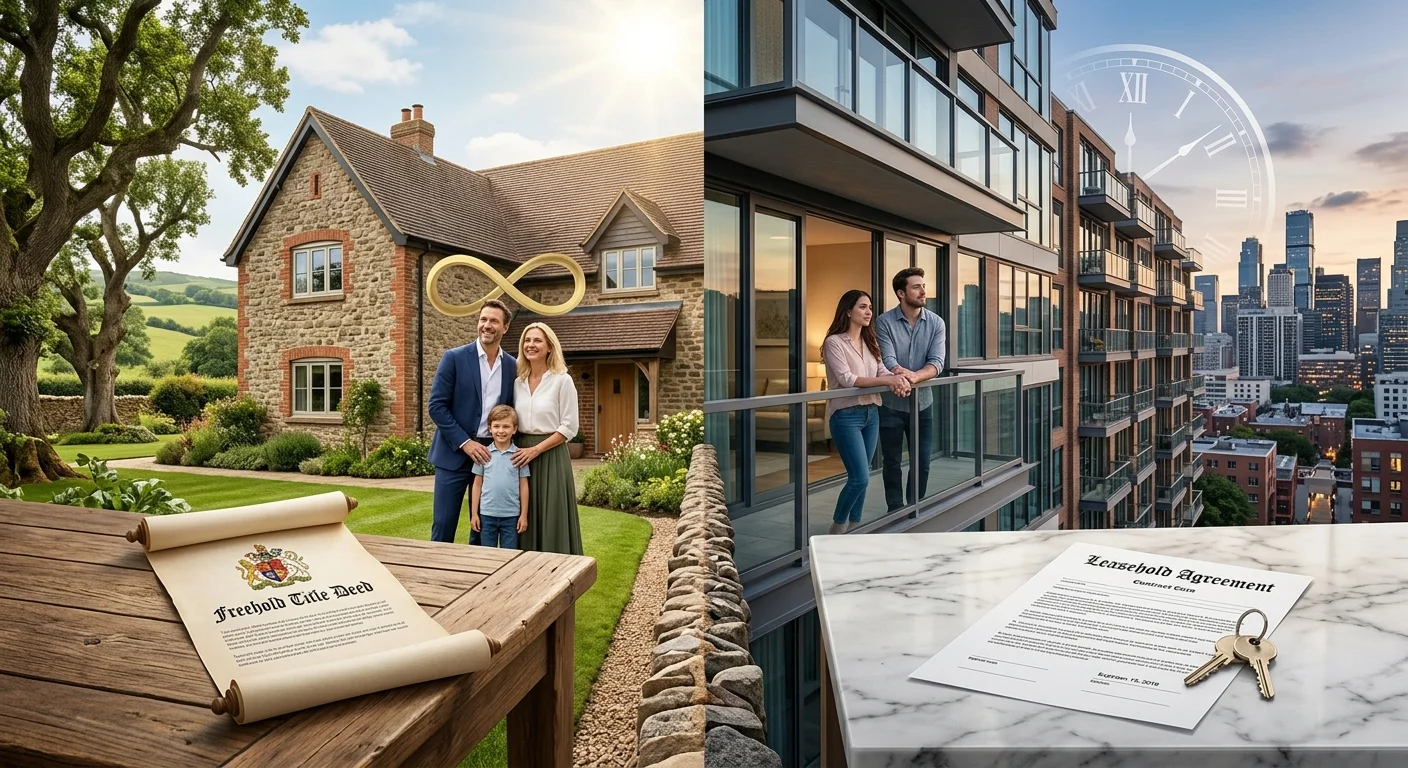
Buying a property is one of the largest financial decisions many people make. Whether the goal is to find a home, generate rental income, preserve capital, or build a long-term investment portfolio, choosing the right type of property can have a major effect on the outcome.
One of the most important decisions buyers face is whether to purchase a ready property or an off-plan property.
A ready property is generally completed and available for immediate or relatively quick occupancy. You can inspect the actual apartment, house, or building, evaluate its condition, understand its surroundings, and potentially begin using or renting it soon after completing the purchase.
An off-plan property, by contrast, is purchased before construction is complete. Depending on the project and stage of development, the buyer may purchase based on architectural plans, specifications, a show unit, digital renderings, or a partially completed structure.
Neither option is automatically better.
The right choice depends on what you value most.
A buyer who needs a home immediately may prioritize certainty and convenience. An investor focused on long-term appreciation may be more interested in the potential pricing advantages and payment plans offered by an off-plan development. Someone who needs rental income soon may prefer a completed apartment, while someone with a longer investment horizon may accept construction risk in exchange for potential upside.
This guide provides a detailed comparison of ready property vs off plan purchases. It examines advantages, disadvantages, risks, financing, timelines, rental income, potential return on investment, resale considerations, due diligence, developer risk, market conditions, and the practical questions buyers should ask before committing.
The central principle is simple:
Do not choose between ready and off-plan property based only on price. Choose based on risk, timing, cash flow, quality, financing, and your investment objectives.
read more about best neighborhood to live
What Is a Ready Property?
Definition of a Ready Apartment or House
A ready property is a completed property that can generally be occupied, used, or rented once the transaction and required procedures are completed.
Examples include:
- Completed apartments
- Finished villas
- Existing townhouses
- Resale homes
- Completed investment units
- Completed commercial properties
The exact legal and practical definition of “ready” varies by market.
A property may be physically finished but still require certain approvals, utility connections, registration procedures, or handover steps before it can be occupied.
Therefore, buyers should not assume that the word “ready” automatically means “move in tomorrow.”
The Main Advantage of Buying Ready
The biggest advantage is visibility.
You can usually see what you are buying.
You can evaluate:
- Actual room sizes
- Finishing quality
- Natural light
- Views
- Noise
- Building condition
- Common areas
- Parking
- Surrounding roads
- Nearby construction
- Actual neighborhood activity
This reduces one category of uncertainty that exists when purchasing an unfinished property.
What Is an Off-Plan Property?
Definition of Off-Plan Property
An off-plan property is purchased before completion.
The buyer may make the decision based on:
- Floor plans
- Architectural drawings
- Master plans
- Specifications
- A show apartment
- Computer-generated images
- A partially completed building
- The developer’s previous projects
Off-plan transactions are common in developing communities and large real estate projects.
Why Developers Sell Off Plan
Selling before completion can help developers secure capital for construction and create early demand for a project.
For buyers, developers may offer:
- Early-buyer prices
- Installment plans
- Lower initial payments
- Promotional incentives
- Different unit selections
- Payment schedules linked to construction milestones
However, these benefits need to be evaluated alongside the risks.
Ready Property vs Off Plan: The Core Difference
The Fundamental Trade-Off
The comparison can be simplified as follows:
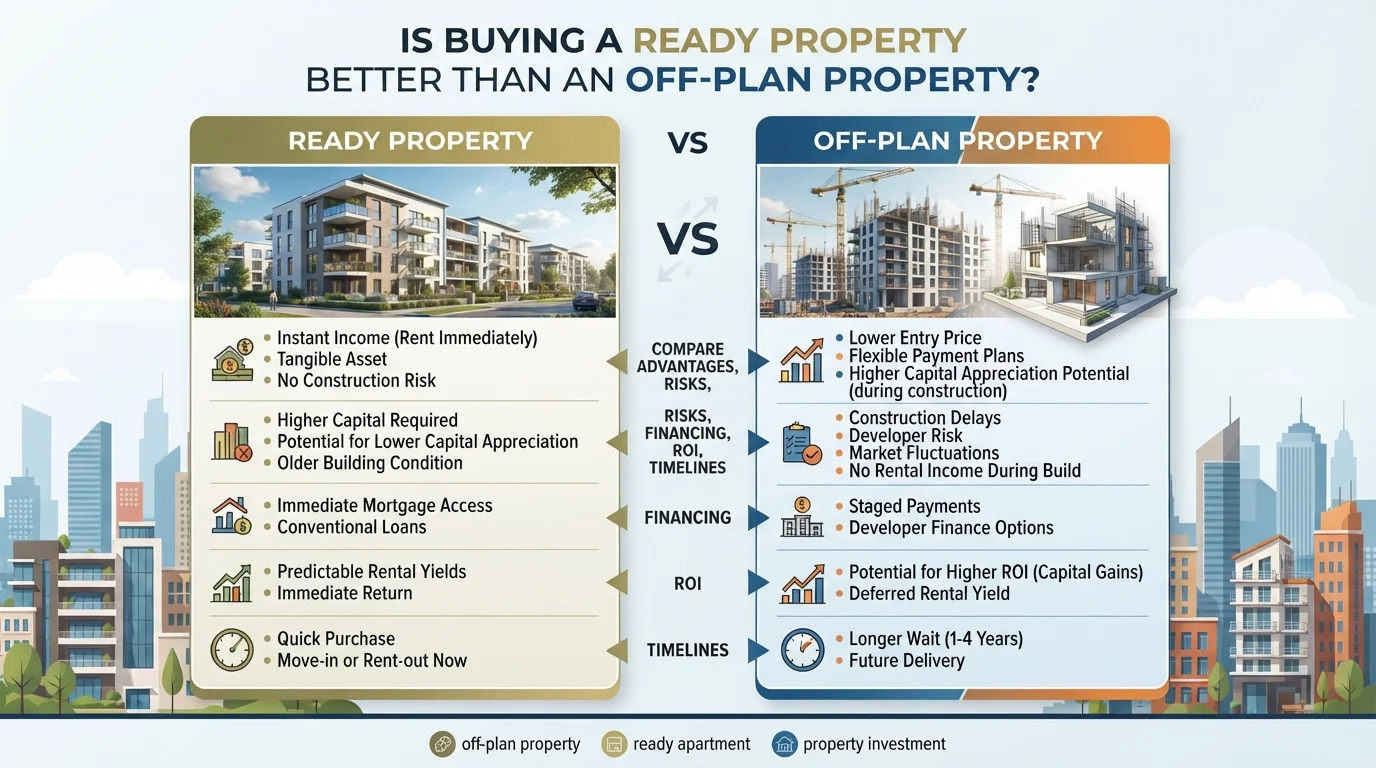
Ready property: More certainty, less waiting, but potentially a higher upfront price.
Off-plan property: More uncertainty and waiting, but potentially greater payment flexibility and future appreciation potential.
This is not a guarantee.
An off-plan property does not automatically generate higher returns, and a ready property is not automatically safer or more profitable.
The actual result depends on the developer, location, purchase price, financing structure, market conditions, property quality, and eventual demand.
read more about new home checklist
Comparing the Two Options at a Glance
Ready Property
| Factor | Ready Property |
|---|---|
| Occupancy | Usually immediate or relatively soon |
| Inspection | Actual property can usually be inspected |
| Rental income | Potentially starts sooner |
| Construction risk | Lower after completion |
| Price certainty | Higher |
| Payment flexibility | Often more limited |
| Location certainty | High |
| Resale visibility | Easier to evaluate |
| Financing | May be easier to structure depending on market |
| Main risk | Condition, overpayment, existing defects, market value |
Off-Plan Property
| Factor | Off-Plan Property |
|---|---|
| Occupancy | Delayed until completion |
| Inspection | Limited before completion |
| Rental income | Delayed |
| Construction risk | Higher |
| Price | May be attractive at launch |
| Payment flexibility | Often stronger |
| Future value | Potential upside, but uncertain |
| Resale | Depends on market and contract |
| Financing | Depends heavily on project and lender |
| Main risk | Delays, developer performance, final quality, market changes |
Price: Which Is Cheaper?
The Initial Purchase Price
One of the main reasons buyers consider off-plan properties is the possibility of obtaining a lower launch price compared with a comparable completed unit.
Developers may price early units strategically to attract initial buyers.
However, comparing prices requires care.
A cheaper off-plan unit is not necessarily a better deal.
You should compare:
- Price per square meter
- Payment schedule
- Maintenance fees
- Parking
- Finishing
- Amenities
- Floor level
- View
- Location
- Delivery date
- Registration costs
- Taxes and transaction fees
- Financing costs
A low headline price can become less attractive when additional costs are included.
Ready Property May Have a Higher Price for a Reason
A completed property provides something the buyer cannot obtain from an off-plan contract:
certainty.
The buyer can see the property, evaluate the building, and potentially use it immediately.
That certainty can justify a price premium.
Payment Plans and Cash Flow
Why Off-Plan Payment Plans Attract Buyers
One of the strongest arguments for off-plan property is the payment structure.
Instead of paying the full purchase price immediately, the buyer may pay through installments.
A hypothetical structure might involve:
- Initial deposit
- Monthly installments
- Quarterly installments
- Construction-linked payments
- Final payment at completion
This can make a property more accessible to buyers who have income available over time but do not want to commit all their capital upfront.
Payment Plans Are Not Free Money
Installments can improve cash flow, but buyers should calculate the total cost.
Ask:
- What is the final purchase price?
- Are there administrative fees?
- Is there an interest component?
- Are installments fixed?
- Are there penalties for late payment?
- What happens if construction is delayed?
- Is the final payment due at handover?
- Are there balloon payments?
The structure matters as much as the headline price.
Financing a Ready Property
Mortgage Financing
Completed properties may be easier to evaluate for mortgage financing because the asset physically exists.
Lenders can often assess:
- Property value
- Location
- Building status
- Ownership documentation
- Existing condition
However, financing rules vary significantly by country, lender, property type, buyer profile, and income.
A buyer should obtain financing information before committing to a purchase.
Down Payment and Monthly Payments
For a ready apartment, buyers should calculate:
Down payment + financing costs + monthly mortgage + service charges + maintenance + insurance + taxes
The purchase should remain affordable under realistic assumptions.
Financing an Off-Plan Property
Developer Installments vs Mortgage Financing
Off-plan buyers may encounter different financing structures.
Some projects rely primarily on developer payment plans.
Others may involve financing from banks or financial institutions.
The important issue is to understand exactly when each payment is due.
A buyer may find the initial installment affordable but later struggle with a large payment due near completion.
Interest Rate Risk
If financing involves variable rates, future payments may change.
Even when the property itself appreciates, financing costs can affect the actual investment return.
This is why ROI should always be calculated after financing costs rather than based solely on property appreciation.
Timeline: Ready Property
Immediate Use
One of the biggest advantages of a ready apartment is speed.
Once the transaction and required handover procedures are complete, you may be able to:
- Move in
- Furnish the unit
- Rent it
- Renovate it
- Resell it
The timeline is usually shorter than an off-plan purchase.
Why Timing Matters for Investors
Suppose two properties have similar prices.
One is ready today.
The other will be delivered in three years.
The ready property may potentially generate rental income during those three years.
The off-plan property cannot usually generate ordinary rental income before completion.
This opportunity cost needs to be included in the investment analysis.
Timeline: Off-Plan Property
Waiting for Completion
An off-plan purchase may involve a waiting period of months or years.
The timeline depends on:
- Construction progress
- Project scale
- Developer performance
- Approvals
- Infrastructure
- Financing
- Market conditions
The expected delivery date should never be treated as an absolute guarantee.
Construction Delays
Delays can happen for many reasons.
Potential causes include:
- Contractor problems
- Supply shortages
- Financing issues
- Regulatory approvals
- Labor shortages
- Infrastructure delays
- Unexpected construction difficulties
A buyer should understand what the contract says about delays.
Rental Income: Ready vs Off Plan
Ready Property and Immediate Rental Potential
A completed property can potentially begin producing rental income soon after acquisition.
The buyer can:
- Purchase the property.
- Complete handover.
- Prepare the unit.
- Market it to tenants.
- Begin receiving rent.
The exact timeline depends on the market and property condition.
Off-Plan Rental Income
An off-plan property generally cannot generate conventional rental income until it is completed and legally usable.
This means the investor must wait.
For an investor using financing, this can be particularly important because loan or installment obligations may exist before rental income begins.
ROI: Which One Offers Better Returns?
Understanding Property ROI
A simple rental yield calculation is:
Annual Rental Income ÷ Property Purchase Price × 100
For example, if a property costs $200,000 and generates $12,000 in annual rent:
$12,000 ÷ $200,000 × 100 = 6% gross rental yield
But this is only a simplified measure.
Actual investment performance should consider:
- Vacancy
- Maintenance
- Service charges
- Property management
- Taxes
- Insurance
- Financing costs
- Renovation
- Transaction costs
Capital Appreciation
Property investors may also benefit from price appreciation.
If a property is purchased for $200,000 and later sold for $240,000, the gross price increase is $40,000.
But again, the actual return is lower after:
- Buying costs
- Selling costs
- Financing
- Taxes
- Renovation
- Holding costs
Off-Plan ROI Potential
An off-plan investment may benefit if the property’s market value increases between purchase and completion.
For example, a buyer might purchase early in a development at a lower price and see the market price rise as construction progresses.
But appreciation is not guaranteed.
If the market declines, the buyer could end up owning a property worth less than the original purchase price.
Ready Property ROI
A ready property may provide more predictable rental analysis because actual rental prices can be observed.
You can investigate:
- Comparable rents
- Occupancy
- Tenant demand
- Vacancy periods
- Nearby rental listings
- Historical transaction prices
This makes financial modeling easier.
read more about increase property value
Market Risk
Off-Plan Has Greater Exposure to Future Conditions
When you buy off plan, you are making a decision about the future.
You are betting, in effect, on:
- Future demand
- Future prices
- Future infrastructure
- Future economic conditions
- Future rental levels
- Future development quality
The longer the construction period, the more variables can change.
Ready Property Provides More Current Information
A ready property lets you analyze the market as it exists today.
You can see:
- Actual neighborhood activity
- Existing businesses
- Current transportation
- Current rental demand
- Existing competition
- Real property condition
This does not eliminate market risk, but it reduces uncertainty.
Developer Risk
Why the Developer Matters
Developer quality is one of the most important considerations in an off-plan purchase.
Research:
- Previous projects
- Delivery history
- Construction quality
- Financial reputation
- Customer reviews
- Handover performance
- Contract terms
- Maintenance standards
Do not evaluate a project solely based on advertising.
Track Record Matters
A developer that has successfully completed multiple projects may provide a different risk profile from an inexperienced company with limited history.
Past performance does not guarantee future performance, but it can provide useful evidence.
Construction Quality
The Risk of Buying Before You Can Inspect
With an off-plan property, you may not be able to inspect the finished apartment before committing.
You are relying on:
- Specifications
- Plans
- Contractual descriptions
- Developer reputation
- Construction standards
The final result may differ in small or significant ways from what you imagined based on marketing materials.
Read the Specifications Carefully
Do not rely only on images.
Check what the contract says about:
- Flooring
- Kitchens
- Bathrooms
- Doors
- Windows
- Fixtures
- Air conditioning
- Electrical systems
- Plumbing
- Built-in appliances
- Finishing level
A rendered image is not the same thing as a contractual specification.
Location Risk in Off-Plan Projects
The Future Neighborhood May Look Different
A major appeal of some off-plan projects is the promise of future infrastructure.
Marketing materials may show:
- Parks
- Schools
- Retail centers
- Roads
- Restaurants
- Entertainment venues
- Transportation links
But these elements may not exist yet.
Their completion may depend on multiple parties.
Ready Property Lets You See the Neighborhood
With a completed property, you can visit at:
- Morning
- Afternoon
- Evening
- Weekdays
- Weekends
This helps you understand:
- Traffic
- Noise
- Parking
- Safety
- Activity
- Accessibility
Resale Potential
Reselling a Ready Property
A ready property can often be easier for a potential buyer to understand because the property exists.
The buyer can:
- Visit it
- Inspect it
- See the view
- Evaluate the building
- Understand the neighborhood
This can make the sales process more tangible.
Reselling an Off-Plan Property
Off-plan resale can be possible in some markets, but it depends heavily on local laws and contract terms.
There may be:
- Assignment restrictions
- Minimum payment requirements
- Developer approval
- Transfer fees
- Registration requirements
Never assume that you can freely resell an off-plan contract.
Check the contract and applicable regulations first.
Liquidity Considerations
What Does Liquidity Mean?
Liquidity refers to how easily an investment can be converted into cash.
Real estate is generally less liquid than many financial assets.
Both ready and off-plan properties can take time to sell.
However, a ready property may be easier for buyers to evaluate because it is tangible.
An off-plan property may appeal to investors seeking future appreciation, but its resale value can depend strongly on market sentiment and project progress.
Ready Property Risks
Existing Defects
A completed property can have problems such as:
- Plumbing issues
- Electrical faults
- Water damage
- Structural concerns
- Poor finishing
- Mold
- Maintenance problems
This is why inspection is essential.
Overpaying
Because the property is visible and available, buyers may become emotionally attached.
Do not assume a beautiful apartment is a good investment.
Compare its price with similar properties.
Older Buildings
Older properties may require:
- Renovation
- Plumbing upgrades
- Electrical improvements
- Waterproofing
- Exterior maintenance
These costs should be included in the investment calculation.
Off-Plan Property Risks
Completion Risk
The project may take longer than expected.
Quality Risk
The finished property may not meet your expectations.
Market Risk
Property prices may decline before completion.
Developer Risk
The developer may face financial or operational difficulties.
Payment Risk
Your financial situation may change before all installments are due.
Opportunity Cost
Your money may remain committed for a long period without rental income.
read more about home buying mistakes
How to Calculate the Real Cost of an Off-Plan Property
Do Not Look Only at the Purchase Price
Calculate:
Purchase price + fees + financing + maintenance + furnishing + expected holding costs
Then compare that total with comparable ready properties.
Include the Time Value of Money
Money paid today is different from money paid several years later.
An installment plan can be financially attractive because it allows you to retain capital longer.
But you should compare the actual economic value of the payment schedule.
How to Calculate the Real Cost of a Ready Property
Include Immediate Costs
For a ready apartment, calculate:
- Purchase price
- Closing costs
- Renovation
- Furniture
- Appliances
- Maintenance
- Service charges
- Financing costs
Then estimate realistic rental income if the property is an investment.
Which Is Better for a Homebuyer?
Ready Property May Suit You If:
You:
- Need to move soon
- Want certainty
- Want to inspect the actual property
- Need immediate access
- Have a clear preferred neighborhood
- Do not want construction risk
Off-Plan May Suit You If:
You:
- Can wait
- Prefer installment payments
- Are comfortable with construction risk
- Have a long-term horizon
- Trust the developer
- Believe the location has strong future potential
Which Is Better for an Investor?
Income-Focused Investors
If your priority is immediate rental income, a ready apartment often has an advantage.
You can study actual rents and potentially begin earning income shortly after purchase.
Appreciation-Focused Investors
An off-plan property may appeal to investors seeking capital appreciation.
But the potential upside comes with greater uncertainty.
The investor must assess whether the expected appreciation justifies:
- Construction risk
- Waiting time
- Market risk
- Developer risk
- Lack of rental income during construction
Which Is Better for First-Time Buyers?
Certainty Can Be Valuable
First-time buyers may benefit from the visibility of a ready property.
Being able to inspect the actual apartment and understand the neighborhood can make the decision easier.
However, first-time buyers with limited budgets may find off-plan payment plans attractive.
The key is not whether the buyer is a beginner.
It is whether they understand the risks.
The Importance of Location
Location Often Matters More Than Property Type
A mediocre property in an excellent location can sometimes outperform a beautiful property in a weak location.
When comparing ready and off-plan options, examine:
- Transportation
- Employment centers
- Schools
- Healthcare
- Retail
- Recreation
- Road access
- Future infrastructure
- Neighborhood reputation
Do not let a flashy development distract you from fundamentals.
Researching Rental Demand
Ask Real Market Questions
If you are buying for investment, investigate:
- What rent do comparable units achieve?
- How long do they remain vacant?
- Who are typical tenants?
- What unit sizes are most demanded?
- Are many new units entering the market?
- What amenities matter to tenants?
Actual rental evidence is more valuable than optimistic projections.
Comparing Rental Yield
Ready Property Example
Imagine a ready apartment costs $150,000.
If it generates $9,000 annual rent:
$9,000 ÷ $150,000 × 100 = 6% gross yield.
Off-Plan Example
Imagine an off-plan apartment costs $120,000.
It is expected to be worth $150,000 at completion.
That sounds attractive, but the investor must consider:
- Whether the $150,000 valuation is realistic
- How long construction will take
- Whether the market may decline
- Whether similar completed properties actually sell for $150,000
- Whether the apartment will generate sufficient rent afterward
Potential appreciation should never be treated as guaranteed profit.
Due Diligence for Ready Properties
Inspect the Property
Consider using qualified professionals to inspect relevant aspects of the property.
Check:
- Structure
- Plumbing
- Electrical systems
- Windows
- Doors
- Water damage
- Air conditioning
- Appliances
- Finishes
Verify Documents
Depending on the jurisdiction, verify:
- Ownership
- Title
- Building approvals
- Outstanding obligations
- Service charges
- Utility status
- Any relevant restrictions
Legal requirements vary by location, so local professional advice can be essential.
Due Diligence for Off-Plan Properties
Research the Developer
Investigate the developer’s history.
Read the Contract
Do not rely on verbal promises.
Pay particular attention to:
- Delivery date
- Delay provisions
- Payment schedule
- Cancellation rights
- Transfer rights
- Specifications
- Size tolerance
- Changes to design
- Maintenance arrangements
- Handover procedures
Verify the Project
Depending on the jurisdiction, confirm that the project has the required approvals and that the developer is authorized to sell units under the applicable rules.
What Questions Should You Ask the Developer?
Before Buying Off Plan
Ask:
What is the contractual completion date?
What happens if delivery is delayed?
What exactly is included in the finishing?
Can the unit size change?
What are the maintenance fees?
What happens if I want to resell?
What are the payment milestones?
What guarantees apply?
What infrastructure will be delivered by the developer?
Which facilities are included and which require additional fees?
The answers should be documented whenever possible.
Emotional Decision-Making
Don’t Fall in Love With the Renderings
Off-plan marketing can be visually impressive.
Beautiful images can make buyers imagine a future lifestyle.
But investment decisions should be based on:
- Numbers
- Contracts
- Evidence
- Location
- Developer history
- Financial capacity
not only emotion.
Ready Properties Can Trigger Emotional Decisions Too
The same problem occurs with completed properties.
A spectacular view or beautiful interior can cause buyers to overlook:
- High price
- Poor rental yield
- Maintenance problems
- Weak location
- Financing costs
Emotion is natural.
It should not control the entire decision.
A Decision Framework
Choose Ready Property If Your Priority Is:
- Immediate use
- Immediate rental potential
- Certainty
- Physical inspection
- Current market evidence
- Lower construction risk
Choose Off Plan If Your Priority Is:
- Payment flexibility
- Longer investment horizon
- Early project pricing
- Potential appreciation
- New construction
- Greater customization in some projects
But each benefit must be weighed against its associated risks.
read more about family home buying guide
Is Buying a Ready Property Better?
There is no universal winner in the ready property vs off plan debate.
A ready property generally provides greater certainty.
You can see what you are buying, inspect the actual unit, assess the surrounding area, and potentially move in or rent it relatively quickly. For buyers who prioritize predictable timelines and immediate utility, these advantages can be extremely valuable.
An off-plan property offers a different proposition.
You may benefit from an early purchase price, structured installments, a new development, and potential capital appreciation as the project progresses. But you also accept greater uncertainty concerning construction, delivery, final quality, market conditions, and future value.
The most appropriate choice depends on your objective.
If you are buying a home, think about when you need to live there, how much uncertainty you can tolerate, and whether you want to inspect the finished property before committing.
If you are buying an investment, calculate both rental yield and potential appreciation while including financing, vacancy, maintenance, transaction costs, and the time during which an off-plan property produces no rental income.
If you are a first-time buyer, do not allow a low initial payment or attractive marketing campaign to substitute for proper due diligence.
If you are an experienced investor, do not assume that additional risk automatically means additional return.
The strongest decision is the one based on a complete financial and practical comparison.
Before signing, compare the ready and off-plan options using the same framework:
Total cost → payment schedule → delivery timeline → rental income → potential appreciation → financing → maintenance → risks → resale → your personal financial capacity.
A property should not be judged only by what it costs today.
It should be judged by what it is likely to cost you, provide you, and require from you over the entire period you plan to own it.
Ready property offers visibility and immediacy. Off-plan property offers flexibility and potential. The better choice is the one whose risk-reward profile matches your goals, timeline, and ability to absorb uncertainty.