Property has long been considered one of the most recognizable forms of wealth building. Whether an investor purchases an apartment, house, commercial unit, office, or another type of real estate, the basic objective is usually the same: acquire an asset with the potential to generate income, preserve capital, and increase in value over time.
However, not every property is automatically a good investment.
A beautiful apartment in an attractive neighborhood may perform poorly as an investment if rental demand is weak, maintenance costs are high, or the purchase price is significantly above comparable properties. Conversely, a property in a less fashionable area may generate strong returns if it benefits from population growth, improving infrastructure, reliable rental demand, and a reasonable entry price.
This is why a comprehensive property investment guide should focus on more than property appearance or short-term price movements.
Successful real estate investment requires analyzing multiple factors, including return on investment, rental demand, potential appreciation, infrastructure development, developer reputation, market trends, operating expenses, financing, location, and the property’s ability to remain desirable over many years.
read more about home buying mistakes
The Difference Between Buying a Property and Buying an Investment
Buying a home for personal use and buying an investment property are not necessarily the same decision.
A homeowner may prioritize views, finishes, layout, schools, lifestyle, or proximity to family. An investor must also ask whether tenants or future buyers will value those characteristics.
For an investment purchase, the property should ideally solve a market need.
That might mean providing affordable housing in an area with a large tenant population, offering premium accommodation in a business district, or supplying commercial space in a growing economic center.
The strongest investments are usually connected to sustainable demand rather than temporary excitement.
The First Principle: Start With the Numbers
Understanding Return on Investment
Return on investment, commonly known as ROI, is one of the most important concepts in real estate investment.
A simple ROI calculation compares the return generated by an investment with the amount of money invested.
For example, suppose an investor purchases a property for $200,000 and generates $12,000 in annual net income after operating expenses. A simplified annual ROI would be:
$12,000 ÷ $200,000 × 100 = 6%
This calculation provides a useful starting point, but real estate returns are more complicated than a single percentage.
Investors should consider acquisition costs, taxes, insurance, maintenance, property management, vacancy periods, financing costs, renovation expenses, and selling costs.
Gross Rental Yield
Gross rental yield provides another quick way to evaluate an investment property.
The formula is:
Annual rental income ÷ Property purchase price × 100
If a property costs $150,000 and produces $12,000 in annual rent, its gross rental yield is 8%.
Gross yield is useful for comparing properties, but it does not represent the investor’s actual profit.
Net Rental Yield
Net rental yield accounts for operating expenses.
These may include:
- Property management
- Maintenance
- Insurance
- Property taxes
- Service charges
- Repairs
- Vacancy
- Landscaping
- Utilities paid by the owner
A property with a high gross rental yield may produce a much lower net yield once expenses are deducted.
Therefore, serious investors should focus on net performance rather than relying exclusively on advertised rental returns.
Rental Demand Is a Critical Investment Factor
Why Tenant Demand Matters
An investment property can only generate rental income when people want to rent it.
This makes rental demand one of the most important factors in any real estate investment decision.
An investor should investigate who the likely tenants are and why they would choose the location.
Potential tenant groups may include:
- Young professionals
- Families
- Students
- Corporate employees
- Healthcare workers
- Tourists
- Retirees
- Industrial workers
- University staff
- Short-term visitors
The stronger and more diversified the tenant pool, the more resilient the property may be.
How to Measure Rental Demand
Investors can study rental listings, occupancy rates, rental prices, vacancy trends, population growth, employment levels, and local development.
If comparable properties are consistently rented quickly at stable prices, that may indicate healthy demand.
On the other hand, a neighborhood with many vacant units and frequent rental discounts may require additional caution.
Rental Demand Should Be Sustainable
Temporary rental demand can create misleading investment opportunities.
For example, a location may experience unusually high demand because of a temporary event, construction project, or short-lived economic boom.
A long-term investor should ask whether demand is likely to remain strong over five, ten, or twenty years.
Sustainable demand is usually connected to durable factors such as employment, education, transportation, healthcare, population growth, and economic activity.
read more about cost of buying a house
Location: The Foundation of Real Estate Investment
Why Location Matters So Much
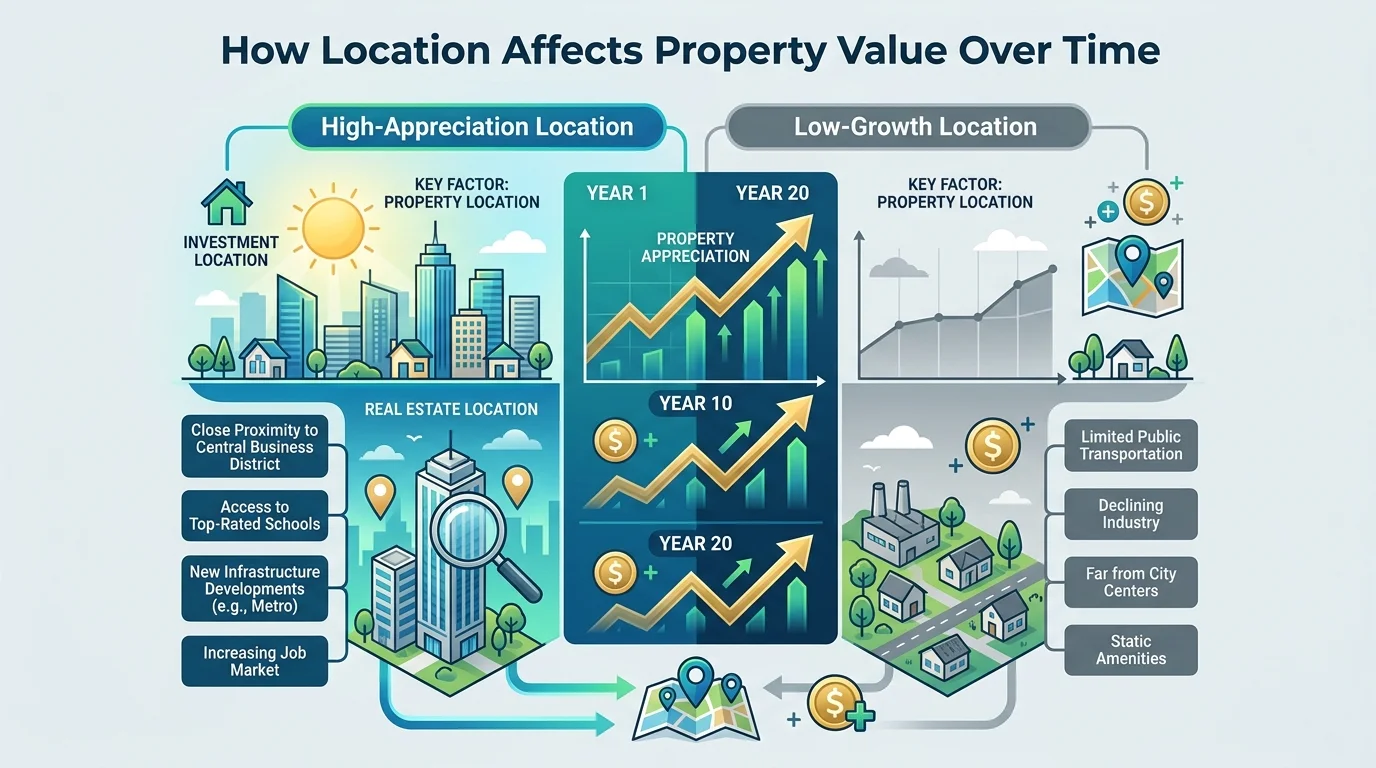
The phrase “location, location, location” remains relevant because investors cannot change the physical location of a property.
An investor can renovate an apartment, improve its interior, or change its management. But the property will remain connected to its surrounding neighborhood.
Location influences rental demand, resale value, tenant demographics, transportation, convenience, and long-term appreciation.
What Makes a Location Attractive?
Important location factors can include:
- Access to major roads
- Public transportation
- Schools and universities
- Hospitals
- Shopping centers
- Employment hubs
- Restaurants
- Entertainment
- Parks
- Business districts
- Airports
- Government facilities
- Tourism attractions
The ideal combination depends on the property type.
A student apartment should be close to educational institutions and transportation, while a family property may benefit more from schools, parks, healthcare, and retail services.
Infrastructure and Long-Term Property Value
Why Infrastructure Can Transform a Market
Infrastructure is one of the strongest external factors influencing real estate markets.
New roads, public transportation systems, airports, hospitals, schools, commercial centers, and utility improvements can make previously overlooked areas more accessible and attractive.
Improved accessibility can increase demand from residents, businesses, and investors.
Existing Infrastructure Versus Planned Infrastructure
Investors should distinguish between infrastructure that already exists and projects that are merely proposed.
A planned highway or transportation project can create future opportunities, but delays and cancellations are possible.
A conservative investor should avoid assuming that every announced project will be completed exactly as promised.
The safest approach is to verify project status and evaluate the property based on current fundamentals as well as realistic future improvements.
Infrastructure and Rental Demand
Infrastructure can influence rental demand directly.
For example, a new transportation connection may reduce commuting time and make a neighborhood more attractive to workers.
Similarly, a new university or hospital can create demand from students, employees, medical professionals, and service businesses.
This is why infrastructure analysis should be a central part of any property investment guide.
Property Appreciation and Capital Growth
What Is Appreciation?
Property appreciation refers to an increase in the market value of a property over time.
For example, if an investor purchases a property for $250,000 and later sells it for $325,000, the property has appreciated by $75,000 before accounting for transaction costs and other expenses.
Appreciation can become a major component of long-term real estate returns.
What Drives Appreciation?
Property values can increase because of several factors:
- Population growth
- Economic expansion
- Limited land supply
- Infrastructure improvements
- Rising household incomes
- New commercial activity
- Improved transportation
- Neighborhood development
- Increased rental demand
- Scarcity of desirable properties
However, appreciation is never guaranteed.
Markets can decline, stagnate, or move sideways for extended periods.
Avoiding Speculative Appreciation
One of the biggest mistakes in real estate investment is buying solely because someone predicts that prices will rise.
An investment should ideally have strong fundamentals even if appreciation takes longer than expected.
Rental income can provide ongoing returns while the investor waits for long-term capital growth.
This combination can be more resilient than relying entirely on future price increases.
Developer Reputation Matters
Why the Developer Should Be Investigated
When buying a newly constructed property or purchasing during an off-plan development, the developer’s reputation can significantly affect investment risk.
A reputable developer is more likely to have experience delivering projects, maintaining construction standards, managing handovers, and supporting buyers.
A developer with a history of delays, poor construction quality, unclear contracts, or weak after-sales service may introduce additional risks.
What to Research About a Developer
Before buying, investors should investigate:
- Previous projects
- Delivery history
- Construction quality
- Customer feedback
- Financial stability
- Maintenance standards
- Legal track record
- Property management arrangements
- Handover performance
- Reputation among existing owners
Investors should avoid relying solely on advertising materials.
Existing projects can provide valuable evidence about how a developer actually operates.
Developer Reputation and Resale Value
Developer reputation can also influence resale demand.
Buyers may feel more comfortable purchasing a property associated with a recognized developer with a proven history.
This can potentially improve liquidity compared with a similar property from an unknown or poorly regarded developer.
Understanding Market Trends
Why Market Trends Matter
Real estate markets move through different phases.
Prices, rents, construction activity, financing conditions, employment, and buyer confidence can change over time.
Investors should understand the broader market before committing substantial capital.
Key Trends to Monitor
A property investor can monitor:
- Property price growth
- Rental growth
- Vacancy rates
- Population changes
- Employment trends
- Mortgage rates
- Construction activity
- New supply
- Infrastructure spending
- Household income
- Business expansion
- Government regulations
Looking at several indicators provides a more complete picture than focusing on one statistic.
Avoid Chasing the Market
When property prices rise rapidly, investors may feel pressure to buy immediately.
This can lead to overpaying.
Strong markets can encourage optimism, but disciplined investors still need to calculate expected returns and compare alternative properties.
A good investment should make financial sense based on reasonable assumptions rather than fear of missing out.
read more about ready property vs off plan
Supply and Demand in Real Estate
Why Supply Matters
Even a growing market can become challenging for investors if too many new properties are built simultaneously.
Excess supply can increase vacancy, slow rental growth, and create competition among landlords.
Investors should therefore examine both current supply and the future development pipeline.
Identifying Undersupplied Markets
A market may offer stronger opportunities when demand is growing faster than new housing supply.
This can occur when population increases, employment expands, and construction is restricted by land availability or planning regulations.
However, investors should verify the numbers rather than assuming scarcity.
The Risk of Overdevelopment
A neighborhood with dozens of new apartment projects may look attractive because of the visible development.
Yet an oversupply of similar units can reduce rental yields and make resale more competitive.
Understanding future supply is therefore essential for buying for investment.
Choosing the Right Property Type
Residential Investment Properties
Residential properties are among the most accessible investment options.
They may include apartments, houses, townhouses, and other housing types.
The main advantages can include a large tenant pool and relatively understandable demand patterns.
However, performance varies substantially depending on location, property type, and tenant demographics.
Commercial Properties
Commercial real estate can offer attractive income potential but may involve more complexity.
Office units, retail spaces, warehouses, and other commercial properties can have different lease structures, tenant risks, maintenance responsibilities, and vacancy periods.
Investors should understand the commercial market before committing capital.
Student Housing
Properties near universities can benefit from recurring demand from students.
However, investors should analyze enrollment trends, competing housing supply, transportation, university reputation, and seasonal vacancy.
Vacation and Short-Term Rentals
Short-term rental properties can generate higher gross income in strong tourism markets, but they may require more active management.
Cleaning, furnishing, marketing, regulation, seasonal demand, and platform fees can significantly affect profitability.
Investors should calculate net income rather than focusing on attractive nightly rates.
Calculating the True Cost of an Investment Property
Purchase Price Is Only the Beginning
A common beginner mistake is calculating returns based solely on the purchase price.
The actual investment can include:
- Down payment
- Closing costs
- Legal fees
- Taxes
- Registration costs
- Financing fees
- Renovation
- Furniture
- Insurance
- Initial repairs
- Property management setup
These expenses can materially change the investment’s return.
Ongoing Operating Costs
Annual expenses should also be estimated.
These may include maintenance, insurance, property taxes, management fees, utilities, association fees, repairs, advertising, and vacancy.
A realistic investment analysis should include conservative estimates rather than assuming the property will always be occupied and require no repairs.
Financing and Leverage
How Mortgage Financing Changes Returns
Borrowing money can allow an investor to control a larger property with less initial capital.
This is known as leverage.
Leverage can increase returns when the property’s net performance exceeds the effective cost of borrowing.
However, leverage also increases risk.
The Danger of Excessive Debt
If rental income falls or interest costs increase, a highly leveraged investor may struggle to meet monthly payments.
Vacancy periods can become particularly dangerous when debt obligations remain fixed.
Therefore, financing should be evaluated under multiple scenarios.
Stress Testing an Investment
Ask what happens if:
- Rent falls by 10%
- The property remains vacant for several months
- Maintenance costs increase
- Interest rates rise
- Property prices decline
- A major repair becomes necessary
An investment that remains manageable under conservative scenarios may be more resilient.
Cash Flow Versus Appreciation
Why Cash Flow Matters
Cash flow represents the money left after rental income and operating expenses.
A property with positive cash flow can help cover financing obligations and provide ongoing income.
Cash flow is particularly important for investors who want regular income rather than relying exclusively on future resale.
Why Appreciation Matters
Appreciation can create significant wealth over long periods.
A property with moderate rental income but strong long-term growth potential may outperform a property with high initial yield but weak capital appreciation.
The best choice depends on the investor’s objectives.
Finding a Balance
A strong long-term investment often combines reasonable rental income with credible appreciation potential.
The ideal balance depends on the market and the investor’s risk tolerance.
Evaluating the Neighborhood
Look Beyond the Property
Investors should walk around the neighborhood and observe the environment.
Look at nearby buildings, traffic, parking, retail activity, construction, public spaces, and general maintenance.
The surrounding environment can affect tenant satisfaction and future resale demand.
Study Comparable Properties
Comparable properties, often called “comps,” help investors understand whether the asking price is reasonable.
Compare properties based on:
- Location
- Size
- Age
- Condition
- Amenities
- Floor
- Parking
- Views
- Property type
- Rental income
Comparisons should be as similar as possible.
Investigate the Local Rental Market
Look at current rental listings and, where possible, historical rental information.
Determine how quickly comparable properties appear to rent and whether landlords are offering discounts or incentives.
This can provide insight into actual rental demand.
The Importance of Property Condition
New Versus Existing Properties
New properties may offer modern designs, newer infrastructure, and lower immediate maintenance requirements.
Existing properties may offer more transparent rental histories and established neighborhood conditions.
Neither option is automatically superior.
Renovation Potential
Some properties may offer value through renovation.
An investor might purchase a property below comparable market value, improve it, and increase rental income or resale appeal.
However, renovation costs must be estimated carefully.
A renovation that costs $30,000 does not automatically add $30,000 or more to the property’s market value.
read more about smart home features
Legal and Regulatory Considerations
Why Legal Due Diligence Matters
A property can look financially attractive while carrying legal complications.
Investors should verify ownership, title, zoning, building approvals, outstanding obligations, and other relevant legal matters.
The exact requirements depend on the country and jurisdiction.
Rental Regulations
Local regulations may affect rental strategies.
Some cities regulate short-term rentals, tenant rights, rent increases, property use, or licensing.
Before buying an investment property, investors should understand the rules that apply to their intended strategy.
Professional Advice
Real estate transactions can involve substantial sums of money.
Legal, tax, financing, and property professionals can help identify risks that a beginner may overlook.
Professional advice does not eliminate investment risk, but it can improve the quality of the decision-making process.
Risk Management in Real Estate Investment
Diversification
Real estate itself is an asset class, but investors can still diversify within property.
For example, an investor might consider different locations, property types, tenant groups, or investment strategies.
Diversification can reduce dependence on one specific market.
Maintaining a Financial Reserve
Property ownership involves unpredictable expenses.
Maintaining an emergency reserve can help cover vacancies, repairs, or unexpected costs without forcing the investor to sell at an unfavorable time.
Avoiding Emotional Decisions
Real estate purchases can be emotional because properties are physical and personal.
A beautiful interior can create excitement, while fear of missing a deal can encourage rushed decisions.
Investors should return to the numbers and fundamentals before committing.
How to Identify a High-Potential Investment Property
Look for Strong Rental Fundamentals
Start with demand.
Ask whether people genuinely want to live or work in the area and whether the property meets their needs.
Strong rental fundamentals create a foundation for income.
Look for Sustainable Appreciation Potential
Study population growth, employment, infrastructure, supply, and neighborhood development.
Do not rely solely on claims that property prices will increase.
Look for a Sensible Purchase Price
Even an excellent property can become a poor investment if purchased at an excessive price.
Calculate expected income and compare the property with alternatives.
Negotiation can sometimes improve the investment’s potential significantly.
Look for Quality and Durability
A property that is well designed, properly maintained, and located in a desirable area may remain competitive for longer.
Quality does not necessarily mean luxury.
It means the property meets the practical expectations of its target market.
Red Flags to Watch For
Unrealistically High Rental Returns
If advertised rental returns appear dramatically higher than comparable properties, investigate why.
The calculation may exclude important expenses or assume unrealistic occupancy.
Heavy Dependence on Future Development
If the entire investment case depends on a project that has not been approved or funded, the risk is higher.
Future development should be treated as potential upside rather than guaranteed value.
Poor Developer Reputation
Repeated construction delays, quality complaints, or unresolved owner issues should be taken seriously.
Weak Rental Demand
A low purchase price does not necessarily make a property attractive.
If tenants are difficult to find, low prices can remain low for a reason.
Excessive New Supply
Large numbers of competing units can put pressure on rents and resale values.
Always investigate the future development pipeline.
A Practical Property Investment Analysis
Example of a Hypothetical Investment
Imagine an investor considers a property priced at $180,000.
The expected annual rent is $14,400.
The gross rental yield would be:
$14,400 ÷ $180,000 × 100 = 8%
Now assume annual operating expenses total $3,600.
Net rental income becomes $10,800.
The simplified net yield is:
$10,800 ÷ $180,000 × 100 = 6%
The property may look attractive, but the investor should continue analyzing financing, taxes, vacancy, future rental growth, expected appreciation, maintenance, and resale costs.
Adding Appreciation
Suppose the property appreciates gradually over several years.
The investor could potentially receive two sources of return:
- Rental income
- Capital appreciation
However, appreciation should not be treated as guaranteed.
A professional investment analysis should model several possible scenarios.
How Market Trends Influence Long-Term Investment Decisions
Population Growth
Population growth can create demand for housing.
But the quality of population growth matters.
A growing population combined with job creation and rising incomes may create stronger demand than population growth without corresponding economic opportunities.
Employment Growth
Employment is a major driver of housing demand.
Areas attracting companies, industrial projects, technology businesses, healthcare facilities, universities, or government investment may experience increased demand for housing.
Infrastructure Expansion
Transportation and public services can make previously inconvenient locations more attractive.
Investors should monitor infrastructure plans while remaining cautious about projects that are uncertain.
Interest Rates
Interest rates can affect affordability, borrowing costs, buyer demand, and investment returns.
When financing becomes more expensive, property demand may weaken in some markets.
Investors using mortgages should pay particular attention to financing conditions.
Building a Long-Term Investment Strategy
Define Your Objective
Before buying, determine what you want the property to achieve.
Possible goals include:
- Monthly income
- Capital growth
- Retirement planning
- Wealth preservation
- Portfolio diversification
- Future personal use
Different objectives can lead to different property choices.
Establish a Holding Period
Long-term property investment generally works best when investors think beyond short-term price movements.
A longer holding period can allow rental income, market growth, and neighborhood development to compound over time.
However, holding a property indefinitely is not automatically beneficial. Investors should periodically review whether the asset still meets their objectives.
Review the Property Regularly
Market conditions change.
Rent levels, operating costs, property values, infrastructure, regulations, and tenant demand can all evolve.
A property that was an excellent investment five years ago may not remain the best use of capital forever.
Regular portfolio reviews help investors identify opportunities and risks.
Frequently Asked Questions About Property Investment
What Makes a Property a Good Long-Term Investment?
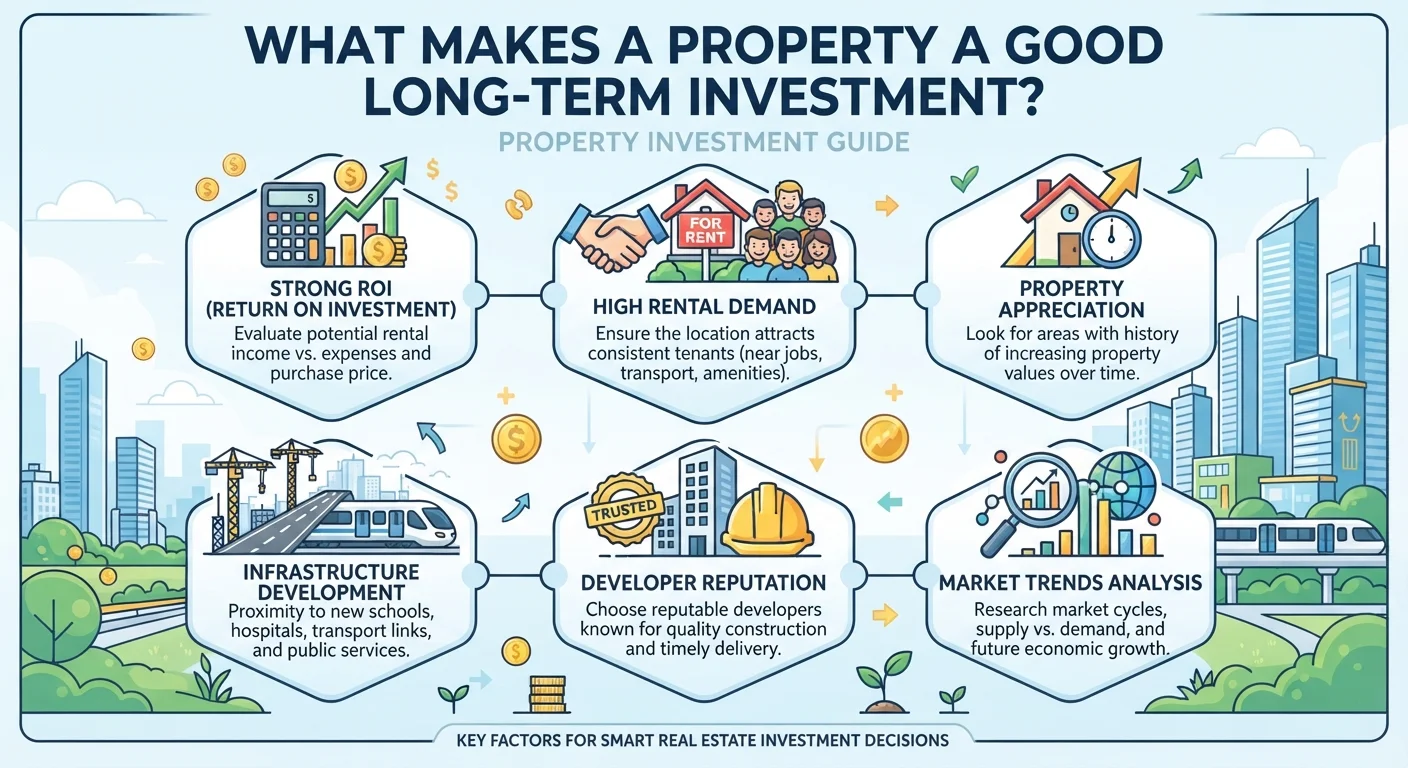
A good long-term investment property generally combines strong rental demand, reasonable acquisition costs, attractive or sustainable rental income, potential appreciation, good infrastructure, a desirable location, manageable operating expenses, and a healthy long-term market outlook.
No single factor guarantees success.
Is Rental Yield More Important Than Appreciation?
Neither is universally more important.
Investors seeking income may prioritize rental yield, while investors focused on wealth accumulation may place greater emphasis on appreciation.
A balanced investment can offer both.
How Important Is Developer Reputation?
Developer reputation can be extremely important, especially when buying a newly built or off-plan property.
A developer’s history can provide clues about construction quality, delivery reliability, management, and resale confidence.
Should I Buy in a Fast-Growing Area?
Fast growth can create opportunities, but growth alone is not enough.
Study infrastructure, employment, population trends, rental demand, property supply, pricing, and future development.
What Is the Biggest Mistake New Property Investors Make?
One of the biggest mistakes is focusing on the purchase price or expected appreciation without calculating the complete financial picture.
Investors should analyze rental income, expenses, financing, vacancy, taxes, maintenance, and resale costs.
Is a High Rental Yield Always a Good Sign?
No.
A high yield can sometimes indicate higher risk, weak capital growth prospects, poor location, difficult tenants, or a property that requires significant maintenance.
Investigate why the yield is high.
read more about cost of buying a house
A successful property investment guide should begin with one simple principle: a good investment property is not necessarily the most beautiful property, the newest property, or the property with the most impressive marketing campaign.
A strong long-term investment is an asset supported by sustainable fundamentals.
Rental demand is one of the most important foundations because consistent tenant interest can provide ongoing income. ROI and rental yield help investors compare opportunities, while net cash flow provides a more realistic picture of financial performance.
Appreciation can add another layer of return, but investors should base growth expectations on factors such as population growth, employment, infrastructure, supply constraints, and neighborhood development rather than speculation.
Infrastructure can transform an area by improving accessibility and attracting residents and businesses. Developer reputation matters particularly when purchasing new or off-plan properties because delivery history and construction quality can affect both risk and resale value. Market trends also need to be monitored because interest rates, supply, demand, employment, and regulations can change the investment environment.
The strongest approach to real estate investment is therefore analytical rather than emotional.
Before buying for investment, evaluate the location, target tenants, rental demand, comparable prices, expected income, operating expenses, financing costs, potential appreciation, future supply, infrastructure plans, developer reputation, and legal conditions.
Most importantly, do not depend on a single prediction. Build several scenarios and ask whether the investment still makes sense if rent grows more slowly than expected, the property remains vacant for several months, expenses increase, or appreciation takes longer.
A property that remains financially manageable under conservative assumptions is often more attractive than one that only works under an optimistic scenario.
Long-term real estate investing is not about finding a property that is guaranteed to increase in value. No investment can offer that certainty. It is about identifying an asset with strong fundamentals, purchasing it at a sensible price, managing it effectively, and allowing time to work in your favor.
When rental demand, location, infrastructure, market trends, property quality, developer reputation, cash flow, and appreciation potential all support the investment thesis, the property has a stronger foundation for long-term success.
That is the real purpose of a thoughtful property investment strategy: not simply to own real estate, but to own an asset that continues to provide value as the market, neighborhood, and economy evolve.