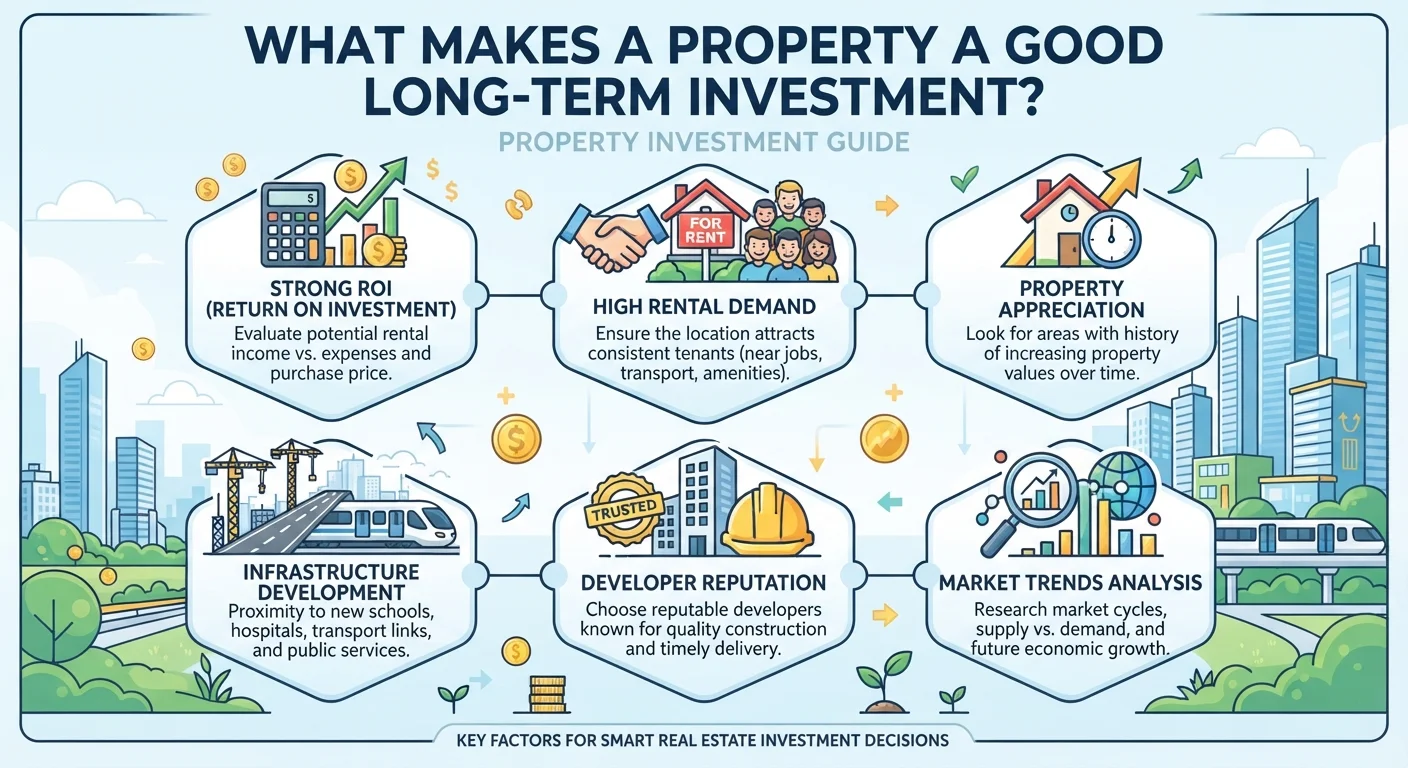
When people discuss buying property, they often focus on the size of the home, the number of bedrooms, the quality of construction, the view, the finishing, or the amenities. All of these factors matter, but there is one characteristic that can be much more difficult to change after purchase: property location.
A property can be renovated, expanded, repainted, furnished, or upgraded. Its location cannot. This is one of the main reasons location has such a powerful influence on property value, rental demand, resale potential, and long-term property appreciation.
A beautifully designed apartment in an inconvenient area may struggle to attract buyers, while an ordinary property in a desirable neighborhood can become increasingly valuable as the surrounding area develops. The difference often comes down to accessibility, infrastructure, employment, schools, services, neighborhood quality, future development, and the supply of comparable properties.
Understanding the relationship between real estate location and value is therefore essential for anyone considering property ownership or real estate investment. The right location does not guarantee profits, but it can significantly influence the probability of maintaining demand and achieving long-term capital growth.
read more about smart home features
Why Property Location Matters So Much
Location Cannot Be Changed
One of the fundamental principles of real estate is that the physical property can change, but the land remains tied to its geographical position.
A buyer can renovate a kitchen, replace flooring, install modern bathrooms, or improve landscaping. However, they cannot move the property closer to a major transportation hub, relocate it beside a business district, or change its distance from a school.
This permanence gives location an unusual importance.
When evaluating an investment, an investor should therefore ask not only, “What am I buying?” but also, “Where am I buying it?”
Location Influences Demand
Property value is strongly connected to demand. When many people want to live, work, rent, or invest in a particular area, properties in that location can become more competitive.
Demand may come from families looking for schools, professionals wanting shorter commutes, students seeking accommodation near universities, tourists looking for convenient locations, or businesses requiring access to customers and transportation.
A location with multiple sources of demand can be more resilient than one dependent on a single type of buyer.
Location Affects the Price Buyers Are Willing to Pay
Two properties with similar sizes and specifications can have dramatically different prices because they are located in different neighborhoods.
For example, a 120-square-meter apartment in a central, well-connected district may command a much higher price than a similar apartment in an isolated area.
The difference is not necessarily the quality of the apartment itself. Buyers are paying for access to the surrounding environment.
read more about cost of buying a house
The Relationship Between Location and Property Appreciation
What Is Property Appreciation?
Property appreciation refers to an increase in the value of a property over time.
Appreciation can result from several factors, including rising demand, population growth, infrastructure improvements, limited supply, economic development, neighborhood improvements, and broader real estate market conditions.
Location influences many of these factors simultaneously.
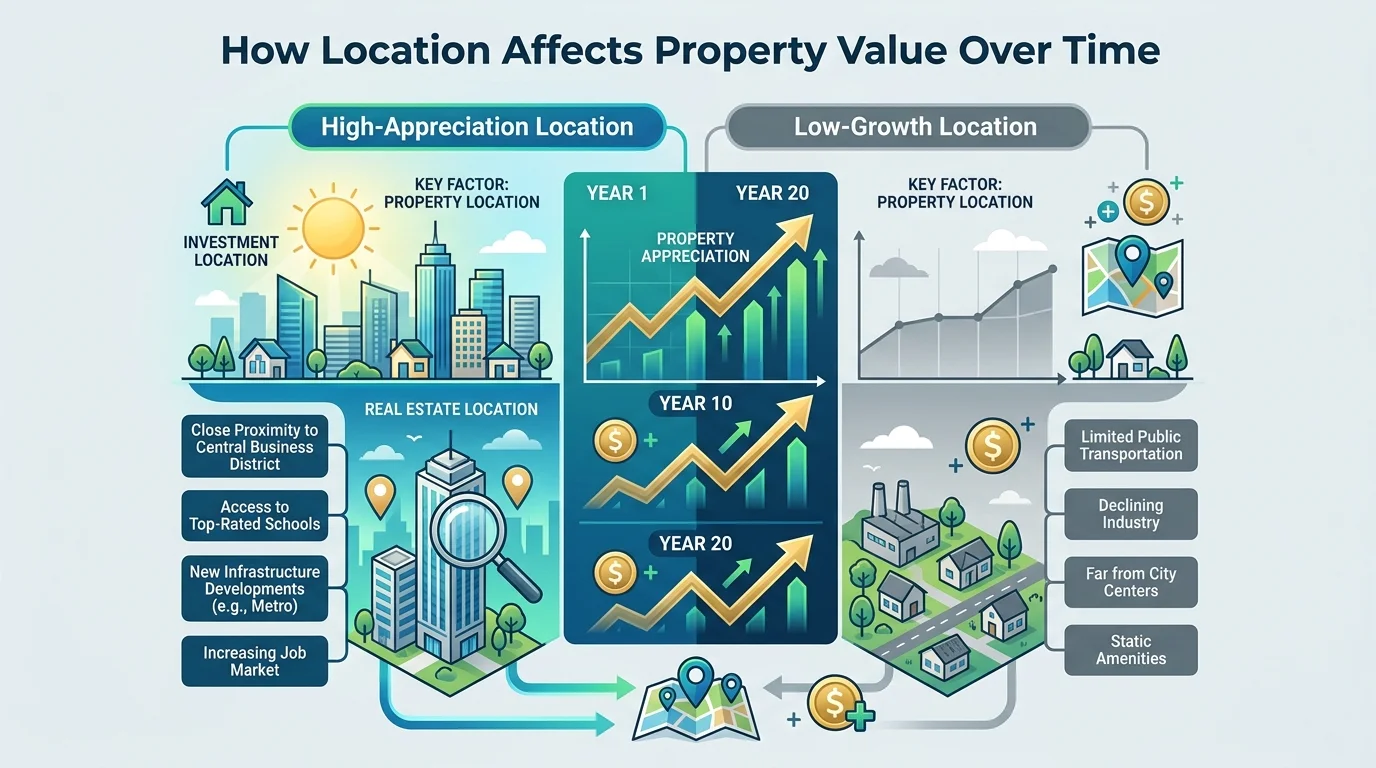
Desirable Locations Can Become More Valuable
Suppose a neighborhood has convenient transportation, strong employment opportunities, good schools, shopping facilities, healthcare services, and limited land available for new development.
If demand continues increasing while supply remains constrained, property prices may rise over time.
The property itself may not have changed significantly. Instead, the surrounding location has become more valuable.
Appreciation Is Not Guaranteed
It is important to avoid assuming that every property in a good location will automatically increase in value.
Real estate markets can experience downturns, oversupply, economic shocks, interest-rate changes, regulatory changes, and shifts in consumer preferences.
A strong location is best understood as a factor that can support long-term demand, not as a guarantee of profit.
How Accessibility Affects Property Value
Proximity to Major Roads
Easy access to major roads can make a property more attractive to people who commute by car.
However, being close to a major road is not always positive. Excessive traffic noise, pollution, congestion, or difficult pedestrian access can reduce desirability.
The ideal location often provides convenient access without placing residents directly beside disruptive infrastructure.
Public Transportation
Access to metro systems, rail stations, bus routes, and other public transportation can have a major impact on property demand.
A property located within a convenient walking distance of reliable transportation may appeal to commuters, students, employees, and households that do not want to depend entirely on private vehicles.
When a new transportation line is introduced, nearby neighborhoods can sometimes experience increased development and stronger demand.
Walkability
Walkability is another important component of modern investment location analysis.
People often value being able to walk to restaurants, supermarkets, pharmacies, parks, schools, cafes, and other services.
A neighborhood where daily needs can be reached easily may attract buyers who are willing to pay a premium for convenience.
The Impact of Employment Centers
Jobs Create Housing Demand
Employment is one of the strongest drivers of residential demand.
When a city develops a major business district, industrial area, technology cluster, financial center, university, hospital network, or tourism industry, workers need places to live.
Properties located within reasonable commuting distance may benefit from this demand.
Example: A New Business District
Imagine a city where a large business district is developed in an area that previously contained mostly low-density housing and undeveloped land.
Thousands of employees begin working in the district. New restaurants, retail stores, schools, transportation services, and residential projects follow.
A property purchased before the area fully develops may experience substantial property appreciation if demand grows faster than available housing.
The important point is that the investment was not necessarily valuable because of the property’s original condition. Its potential came from the transformation of its surrounding location.
Schools and Property Value
Why Schools Influence Family Demand
Families often place a high priority on access to quality schools.
A property located near respected educational institutions may attract more families and therefore maintain stronger buyer and rental demand.
School quality can also influence how long residents stay in an area, which can contribute to neighborhood stability.
The Real-Life Principle
Across many housing markets, properties located in desirable school districts often command premiums compared with otherwise similar properties outside those districts.
This does not mean investors should buy solely because of a school. School boundaries, enrollment policies, local demographics, and future changes should also be investigated.
The broader lesson is that services that matter to households can become embedded in the value of the surrounding real estate.
Healthcare and Property Location
Hospitals as Demand Drivers
Major hospitals and healthcare centers can create employment and attract patients, professionals, students, and service businesses.
Areas near major medical institutions may therefore experience strong rental demand.
Doctors, nurses, administrative staff, medical students, and other professionals may prefer housing that minimizes commuting time.
Supporting Businesses
Healthcare hubs can also attract pharmacies, restaurants, convenience stores, transportation services, and other businesses.
As these services develop, the neighborhood may become more convenient, increasing its attractiveness to residents.
Retail and Lifestyle Amenities
Everyday Convenience Matters
People often underestimate how much nearby amenities influence their housing decisions.
A property near supermarkets, restaurants, gyms, cafes, pharmacies, parks, and entertainment facilities can provide a lifestyle advantage.
This convenience can make an area more desirable than a similar property located farther away from everyday services.
Premium Lifestyle Districts
Some neighborhoods become desirable because they offer a particular lifestyle.
Waterfront areas, historic districts, cultural centers, shopping districts, entertainment zones, and restaurant destinations can attract residents who value experiences and convenience.
When these areas maintain strong demand and limited supply, properties can command substantial premiums.
read more about property investment guide
Infrastructure and Neighborhood Transformation
Infrastructure Can Change a Location’s Value
Infrastructure investment can transform previously overlooked neighborhoods.
New roads, bridges, public transportation, airports, schools, hospitals, utilities, parks, and commercial centers can improve accessibility and functionality.
As a result, the perceived value of the surrounding land can increase.
Example: Transportation-Led Growth
Consider a neighborhood located far from a city center but positioned along a planned transit corridor.
Before the project, commuting may be inconvenient. After the transit system becomes operational, travel times decrease.
Developers may begin constructing residential buildings, shops, and offices. Population increases, businesses arrive, and demand for nearby housing grows.
An investor who identified the location before the transformation could potentially benefit from the resulting increase in demand.
However, the critical word is “potentially.” Planned infrastructure can face delays, cancellation, budget problems, or changes in scope.
Supply and Location
Limited Land Can Support Prices
One reason certain locations become extremely expensive is limited supply.
Central districts, waterfront areas, established neighborhoods, and areas surrounded by protected land may have little room for additional development.
When demand continues to grow while new supply remains constrained, competition among buyers can support higher prices.
Oversupply Can Reduce Appreciation
A location can also suffer from excessive construction.
If developers build thousands of similar apartments at the same time, investors may face stronger competition when trying to rent or sell.
Even a seemingly attractive neighborhood can experience weak property appreciation if supply consistently exceeds demand.
This is why location analysis should include both demand and future supply.
The Importance of Neighborhood Reputation
Perception Influences Real Value
Real estate value is not determined only by measurable physical characteristics.
The reputation of a neighborhood can influence how buyers perceive it.
A district known for safety, cleanliness, good services, attractive public spaces, or strong community identity may command higher prices.
Conversely, areas associated with poor infrastructure, insecurity, pollution, or neglected buildings may struggle even when individual properties are attractive.
Reputation Can Change
Neighborhood reputation is not permanent.
Urban regeneration can transform declining districts. New businesses, public investment, infrastructure improvements, and population changes can gradually alter how an area is perceived.
This creates opportunities for investors who can identify neighborhoods undergoing sustainable improvement rather than temporary speculation.
Location and Rental Demand
Why Investors Should Study Tenants
For income-focused investors, resale value is only one consideration.
Rental demand matters because a property with strong tenant demand can generate income while the investor waits for long-term appreciation.
Different tenant groups prefer different locations.
Students may prioritize proximity to universities. Professionals may prioritize transportation and business districts. Families may prioritize schools and quiet neighborhoods.
Understanding the target tenant is therefore essential.
Vacancy Risk
A property can have an attractive purchase price but still be a poor investment if it is difficult to rent.
High vacancy rates can reduce income and increase the investor’s carrying costs.
A strong rental location should ideally have multiple sources of tenant demand rather than depending on one temporary factor.
Location and Resale Value
Buyers Compare Alternatives
When selling a property, buyers usually compare it with other properties in nearby areas.
If your property is located in a highly desirable neighborhood, you may benefit from stronger competition among buyers.
If the location has weak demand, even a renovated property may struggle to command a premium.
Liquidity Matters
Real estate is generally less liquid than many financial assets.
Selling can take time, and transaction costs can be significant.
A property in a location with a large pool of potential buyers may be easier to sell than a property in an area with limited demand.
This is an important part of evaluating real estate location.
Micro-Location Matters as Much as the City
Two Streets Can Have Different Values
Choosing a good city is not enough.
Two neighborhoods within the same city can have very different characteristics. Even two streets within the same neighborhood can differ because of noise, views, access, traffic, building quality, and nearby services.
This is why investors should analyze the exact location rather than relying solely on the city’s reputation.
Corner vs. Interior Locations
A corner property may have better visibility and access, while an interior property may offer more privacy and less traffic.
For commercial real estate, visibility can be extremely important. For residential property, quietness and privacy may matter more.
The best micro-location depends on the intended use.
Noise and Environmental Factors
Not All Proximity Is Positive
Being close to amenities can increase convenience, but excessive proximity can create disadvantages.
A property directly beside a nightclub, major highway, railway line, airport, industrial facility, or busy commercial street may experience noise and pollution.
Investors should therefore distinguish between being close enough to benefit from an amenity and being so close that the negative effects outweigh the benefits.
Views and Natural Features
Waterfront views, parks, mountains, green spaces, and attractive city views can influence property prices.
Properties with unique views may be difficult to replicate because surrounding land may be limited.
However, investors should verify whether the view is actually protected or whether future development could block it.
Crime, Safety, and Property Value
Safety Influences Demand
Perceived and actual safety can strongly affect residential demand.
Families, professionals, students, and retirees may all consider safety when choosing where to live.
A location that becomes safer and better managed can experience stronger demand over time.
Research Beyond Marketing Claims
Investors should not rely entirely on a developer’s description of a neighborhood.
Research local crime information where available, visit the area at different times, speak with residents, and observe surrounding conditions.
A location can feel completely different during the day and at night.
read more about home layout ideas
Future Development and Investment Location
Look Beyond the Present
One of the biggest mistakes investors make is analyzing only what exists today.
Real estate is a long-term asset. A neighborhood that looks average today may become highly desirable if major development is genuinely underway.
Conversely, a location that appears premium today may face problems if congestion, oversupply, or declining infrastructure develops.
Study Planned Projects Carefully
- Future projects can include:
- New transportation systems
- Business districts
- Shopping centers
- Universities
- Hospitals
- Parks
- Hotels
- Entertainment areas
- Industrial zones
- Residential communities
However, investors should distinguish between confirmed projects and promotional promises.
A proposed development that has no clear financing, approvals, construction schedule, or official progress should not be treated as guaranteed future value.
Real-Life Example: Transit Expansion
From Peripheral Area to Connected Neighborhood
Imagine an outer neighborhood that historically attracted buyers because of affordable prices.
For years, residents faced long commutes. Then a major public transportation project connects the neighborhood to the central business district.
Travel becomes easier, businesses begin opening nearby, and developers increase residential construction.
Demand increases because the location now offers something it previously lacked: accessibility.
Existing property owners may benefit from rising demand and improved resale potential.
The Lesson for Investors
The lesson is not simply “buy near a future train station.”
Instead, investors should identify why transportation will change demand, determine whether the project is realistic, analyze the current price compared with similar locations, and consider how much new housing will be created.
Real-Life Example: A Growing University Area
Student Demand Creates a Local Property Market
Suppose a university expands its campus and student population.
Housing demand increases. Students need apartments, shared housing, studios, restaurants, cafes, transportation, and other services.
Properties within convenient commuting distance may experience stronger rental demand.
The Investment Consideration
A university can be a powerful demand driver, but investors should analyze student enrollment trends, university stability, housing supply, rental regulations, and seasonal vacancy.
A property may generate strong demand but still produce disappointing returns if too many competing apartments are built.
Real-Life Example: Urban Regeneration
From Neglected District to Popular Neighborhood
Many cities have examples of former industrial or neglected districts being transformed into residential and lifestyle destinations.
Public investment may improve streets and parks. Developers may convert old buildings into apartments. Restaurants, galleries, cafes, and offices may follow.
As the area’s reputation improves, buyers who previously avoided it may begin considering it.
Why Early Investors Can Benefit
Investors who purchase during the early stages of sustainable regeneration may potentially benefit from future appreciation.
But early-stage investment is also riskier. Not every regeneration project succeeds.
The investor must determine whether there are actual signs of transformation rather than relying on optimistic predictions.
read more about questions to ask before buying a house
The importance of property location comes from one simple fact: you can change almost everything about a property except where it sits.
You can renovate the interior, upgrade the kitchen, improve the landscaping, replace fixtures, or redesign the layout. But you cannot move the property closer to jobs, transportation, schools, hospitals, parks, shopping centers, or other demand drivers.
This is why real estate location should be one of the first factors considered when evaluating an investment.
The strongest locations tend to combine several advantages: accessibility, employment, desirable services, infrastructure, neighborhood quality, limited supply, and sustainable demand. When these characteristics improve or remain strong over time, they can support rental demand, resale value, and property appreciation.
Real-life examples of transit expansion, university growth, business districts, and urban regeneration demonstrate how changes around a property can influence its value even when the building itself remains relatively unchanged.
However, investors should avoid treating location as a guarantee of profit. A famous neighborhood can become overpriced, a planned infrastructure project can be delayed, and an attractive area can experience oversupply. Successful property analysis requires looking at both present conditions and realistic future possibilities.
The best investment location is therefore not simply the most expensive neighborhood or the most fashionable district. It is a location where current demand, future potential, supply conditions, accessibility, and purchase price create a reasonable foundation for long-term value.
When evaluating your next property, remember to look beyond the walls of the building. Study the street, neighborhood, transportation network, employment centers, services, development plans, competing supply, and people who are likely to want to live or invest there in the future.
In real estate, the building matters. But the place where that building stands can determine how much demand it attracts, how easily it can be rented, how competitive it is when sold, and how its value may evolve over time.