Buying a home is often described as choosing the right property, but the property itself is only part of the decision. A beautiful house in an inconvenient or poorly planned location can become frustrating to live in, while a modest home in a well-connected, safe, and growing community may provide a much better long-term experience.
This is why searching for the best neighborhood to live in should be just as important as evaluating the house itself.
A neighborhood influences your daily routine, access to essential services, commute time, children’s education, recreation, shopping convenience, and even the future value of your property. The surrounding environment can affect how much time you spend traveling, how comfortable your family feels outdoors, and how attractive your home remains to future buyers or renters.
For homebuyers, the ideal neighborhood is rarely identical for everyone. A young professional may prioritize transportation and restaurants, while a family with children may focus heavily on schools, parks, safety, and healthcare. Retirees may value quiet streets, medical facilities, and convenient shopping.
The most important thing is to understand which neighborhood features have a meaningful effect on both quality of life and property value.
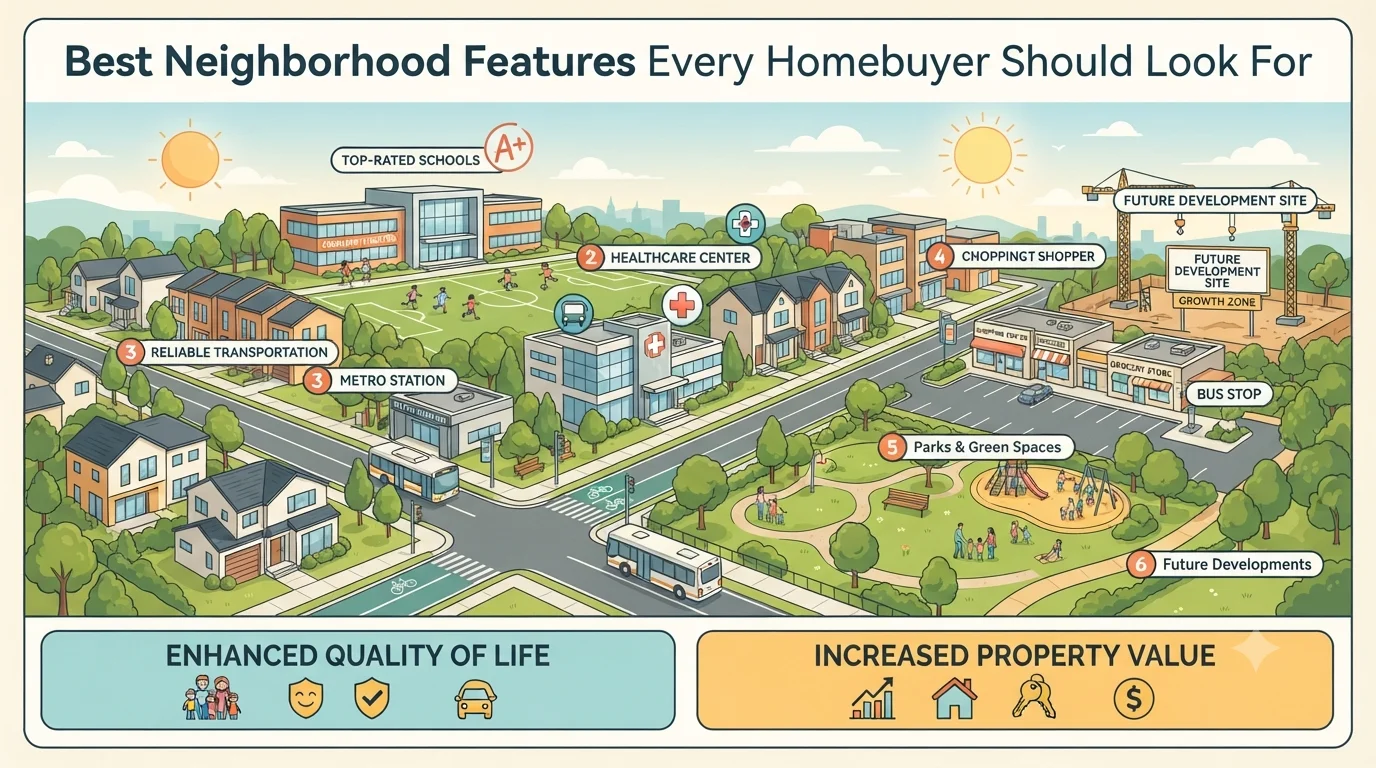
This guide explains the major factors to evaluate before choosing a neighborhood, including schools, hospitals, transportation, shopping centers, parks, safety, residential character, infrastructure, and future development.
read more about pet-friendly communities
Why Neighborhood Choice Matters So Much
Your Home Is Part of a Larger Environment
A property does not exist in isolation.
When you purchase a home, you are also buying access to its surroundings.
The surrounding neighborhood determines:
- How easily you can reach work.
- Where your children can attend school.
- How quickly you can access healthcare.
- Where you buy groceries.
- Where you exercise.
- How you spend weekends.
- How convenient your daily life becomes.
- How attractive the property may be to future buyers.
A house can be renovated, expanded, or redecorated.
The neighborhood is much harder to change.
Location Can Influence Property Value
Real estate value is affected by many variables, including the property’s size, condition, design, supply and demand, and market conditions.
However, location remains one of the most important considerations.
Homes in desirable neighborhoods often benefit from stronger demand because buyers are not simply paying for walls and rooms. They are paying for access, convenience, safety, services, and lifestyle.
This is why evaluating the surrounding area should happen before you become emotionally attached to a particular property.
What Makes the Best Neighborhood to Live In?
There Is No Universal Definition
There is no single neighborhood that is perfect for everyone.
The best neighborhood to live in depends on your lifestyle, budget, priorities, and future plans.
However, strong neighborhoods commonly share several characteristics:
- Good accessibility.
- Reliable infrastructure.
- Reasonable safety.
- Quality schools nearby.
- Healthcare access.
- Shopping and essential services.
- Parks and green spaces.
- Convenient transportation.
- Pleasant residential streets.
- Appropriate future development.
- Healthy demand for housing.
The combination matters more than any individual feature.
A neighborhood may have excellent schools but terrible transportation. Another may have excellent shopping but excessive traffic.
The goal is to evaluate the entire environment.
Start With Your Personal Priorities
Define Your Lifestyle Before Comparing Neighborhoods
Before researching neighborhoods, make a list of what matters most to you.
Ask yourself:
- Do I have children?
- Will I have children in the future?
- How often do I commute?
- Do I drive every day?
- Do I need public transportation?
- How close do I want to be to hospitals?
- Do I prefer a quiet or active area?
- Do I want parks within walking distance?
- How important are restaurants and shopping?
- Am I buying for long-term living or investment?
Your answers will determine which neighborhood features deserve the most attention.
Separate Needs From Preferences
This is a useful exercise.
For example:
Needs:
- Safe environment.
- Reliable transportation.
- Nearby school.
- Access to healthcare.
Preferences:
- Coffee shops.
- Large shopping mall.
- Walkable streets.
- Modern apartment buildings.
Understanding this difference can prevent you from rejecting a strong neighborhood because it lacks a feature that is merely convenient rather than essential.
Safety Should Be a Major Consideration
What Makes a Safe Neighborhood?
Safety is more complicated than looking at a crime statistic.
A safe neighborhood may have:
- Well-maintained streets.
- Good lighting.
- Visible activity.
- Responsible property maintenance.
- Reliable emergency services.
- Controlled access where appropriate.
- Strong community engagement.
Crime data can be useful, but it should not be your only source of information.
Visit at Different Times
A neighborhood can feel completely different at:
- 8 a.m.
- 2 p.m.
- 7 p.m.
- 11 p.m.
- Weekdays.
- Weekends.
Try to visit more than once.
During the day, you may see families, workers, and students.
At night, you may notice:
- Street lighting.
- Noise.
- Parking pressure.
- Empty streets.
- Commercial activity.
These details can significantly affect your perception of the area.
Look at Street Lighting
Lighting Affects Comfort and Perceived Safety
Good lighting can make sidewalks, parking areas, entrances, and public spaces easier to navigate at night.
Look for:
- Functional streetlights.
- Lighting around entrances.
- Well-lit pedestrian paths.
- Lighting in parking areas.
Broken or poorly positioned lights may indicate maintenance issues.
read more about preparing your home for a dog
Evaluate the Condition of the Streets
Infrastructure Says a Lot About a Neighborhood
Pay attention to:
- Road quality.
- Sidewalks.
- Drainage.
- Curbs.
- Street signs.
- Traffic signals.
- Public landscaping.
A neighborhood with consistently maintained infrastructure may be more attractive to residents and future buyers.
Check for Drainage Problems
Water accumulation after rainfall can indicate drainage issues.
If possible, visit after or during wet weather.
Look for:
- Standing water.
- Flood-prone intersections.
- Damaged roads.
- Water stains around buildings.
These issues can affect both daily comfort and property maintenance costs.
Schools and Property Value
Why Schools Matter
For families, schools can be one of the most important neighborhood factors.
A family-friendly community often benefits from access to reputable educational institutions.
Schools influence neighborhood demand because parents may prioritize living within reasonable reach of their preferred schools.
Evaluate More Than Distance
A school being nearby does not automatically mean it is the best option.
Research:
- Academic reputation.
- Curriculum.
- Admission requirements.
- Class sizes where available.
- Transportation.
- School facilities.
- Reviews from multiple sources.
- Future plans.
Consider School Access Over Time
A home that works for a family with a five-year-old may not work as well when that child becomes a teenager.
Think about the full educational journey.
Consider access to:
- Early education.
- Primary schools.
- Secondary schools.
- Specialized education.
- Higher education or vocational options where relevant.
School Commute Matters Too
Shorter Travel Can Improve Daily Life
A school may be technically nearby but difficult to reach because of traffic.
Ask:
- How long does the trip take during school hours?
- Are there safe walking routes?
- Is school transportation available?
- Does traffic become congested at pickup time?
A five-minute trip on an empty road can become a much longer journey during peak hours.
Hospitals and Healthcare Access
Healthcare Is a Long-Term Neighborhood Feature
Hospitals, clinics, pharmacies, and diagnostic centers can significantly influence quality of life.
You may not need healthcare services every day, but accessibility becomes extremely valuable when an emergency occurs.
What to Look For
Evaluate access to:
- General hospitals.
- Emergency departments.
- Clinics.
- Pharmacies.
- Dental services.
- Pediatric care.
- Specialist medical centers.
Distance Isn’t Everything
A hospital located three kilometers away may not be practically convenient if roads are heavily congested.
Consider travel time rather than distance alone.
Emergency Services
Think Beyond Hospitals
A strong neighborhood should have reasonable access to emergency services.
Depending on the location, this may include:
- Ambulance services.
- Fire services.
- Police or other emergency authorities.
Understanding how quickly emergency assistance can reach the area can provide peace of mind.
Transportation and Connectivity
Transportation Can Define a Neighborhood
A neighborhood may look attractive on a map but become inconvenient if every important destination requires a long drive.
Evaluate:
- Main roads.
- Public transportation.
- Bus routes.
- Rail access.
- Taxi availability.
- Ride-hailing accessibility.
- Airport or major transport connections.
Consider Your Daily Commute
Calculate your real commute during peak hours.
Do not rely entirely on a navigation app’s off-peak estimate.
If possible, travel the route during the same time you would normally commute.
Walkability
Can You Reach Basic Needs Without a Car?
Walkability can significantly improve quality of life.
A neighborhood becomes more convenient when residents can safely walk to:
- Grocery stores.
- Pharmacies.
- Cafes.
- Parks.
- Schools.
- Public transportation.
Sidewalk Quality Matters
A neighborhood may technically have sidewalks, but they may be:
- Broken.
- Narrow.
- Blocked.
- Poorly lit.
- Difficult for wheelchairs or strollers.
Walkability should be evaluated in real conditions rather than simply by looking at a map.
Public Transportation
Evaluate Reliability, Not Just Availability
A bus stop nearby is useful only if the service is reasonably reliable and connects to places you actually need to reach.
Check:
- Frequency.
- Operating hours.
- Routes.
- Transfers.
- Peak-time congestion.
For people who do not want to rely entirely on cars, transportation can be one of the most important neighborhood features.
Shopping Centers and Daily Convenience
Shopping Is About More Than Entertainment
A shopping center can provide convenient access to:
- Groceries.
- Pharmacies.
- Clothing.
- Household products.
- Restaurants.
- Banking.
- Personal services.
Having essential services nearby can save significant time.
Grocery Stores Are Particularly Important
A neighborhood with restaurants but no convenient grocery options may still be inconvenient for daily living.
Look for:
- Supermarkets.
- Local grocery stores.
- Fresh food markets.
- Convenience stores.
Consider both distance and accessibility.
Restaurants and Cafes
Dining Options Affect Lifestyle
Restaurants may not be essential for everyone, but they contribute to neighborhood convenience and lifestyle.
A diverse selection can include:
- Casual restaurants.
- Family dining.
- Cafes.
- Takeaway options.
- Bakeries.
- Specialty food businesses.
However, too many restaurants may also create:
- Traffic.
- Parking problems.
- Noise.
- Evening activity.
The ideal balance depends on your preferences.
Parks and Green Spaces
Why Parks Matter
Parks can improve the livability of a neighborhood by providing places for:
- Walking.
- Exercise.
- Children’s play.
- Relaxation.
- Social interaction.
- Outdoor activities.
For families, nearby parks can be especially valuable.
Green Space Can Support Quality of Life
A neighborhood with trees and accessible green spaces may feel less dense and more comfortable.
Green spaces can also create opportunities for outdoor activity without requiring a long drive.
read more about first-time home buyer
Family-Friendly Community Features
What Makes a Family-Friendly Community?
A family-friendly community often has a combination of:
- Safe streets.
- Schools.
- Parks.
- Healthcare.
- Family-oriented activities.
- Reasonable traffic.
- Child-friendly public spaces.
But family friendliness is not just about having playgrounds.
Observe how people actually use the neighborhood.
Do families walk outside?
Are children using public spaces?
Are parks maintained?
Do sidewalks accommodate strollers?
These observations can tell you more than a marketing description.
Playgrounds and Children’s Facilities
Inspect the Quality of Public Play Areas
If you have children, do not simply note that a playground exists.
Check:
- Maintenance.
- Shade.
- Seating.
- Safety surfaces.
- Age-appropriate equipment.
- Lighting.
- Cleanliness.
A neglected playground may not provide much practical value.
Noise Levels
Visit During Different Hours
Noise can come from:
- Traffic.
- Restaurants.
- Schools.
- Construction.
- Commercial businesses.
- Airports.
- Entertainment venues.
A property can appear peaceful during an afternoon viewing but become noisy at night.
Consider Your Personal Tolerance
Some people enjoy lively neighborhoods.
Others need quiet surroundings to sleep or work from home.
There is no universal answer.
The important thing is to choose deliberately.
Traffic and Parking
Traffic Can Change a Neighborhood Completely
High traffic may affect:
- Noise.
- Air quality.
- Safety.
- Commute times.
- Parking availability.
Check major roads near the property.
Also investigate whether traffic increases during:
- School hours.
- Business hours.
- Weekends.
- Events.
Parking Availability
Ask:
- Is private parking included?
- Is street parking available?
- Is parking difficult at night?
- Do businesses nearby attract additional cars?
Parking problems can become a daily source of frustration.
Air Quality and Environmental Conditions
Look Beyond the Property Boundary
Air quality can be affected by:
- Heavy traffic.
- Industrial activity.
- Construction.
- Waste facilities.
- Commercial operations.
If you have respiratory sensitivities or young children, environmental conditions may deserve additional attention.
Odors Can Be a Warning Sign
Visit the area and pay attention to smells.
Persistent odors from industrial or waste-related sources may affect quality of life.
Property Maintenance Around the Neighborhood
Look at Neighboring Properties
Do not evaluate only the house you are buying.
Look at surrounding buildings.
Are they:
- Well maintained?
- Vacant?
- Under construction?
- Deteriorating?
- Professionally managed?
A well-maintained residential area may feel more attractive and stable.
Residential Area Character
Understand the Type of Neighborhood
Some residential areas are primarily:
- Family-oriented.
- Student-oriented.
- Luxury-focused.
- Mixed-use.
- Retirement-oriented.
- High-density urban communities.
Choose an environment that fits your lifestyle.
Population Stability
A neighborhood with a stable resident population may feel different from an area dominated by short-term rentals or temporary occupancy.
Think about whether you prefer:
- Quiet long-term residents.
- High social activity.
- A mixed population.
Property Types in the Neighborhood
Diversity Can Be Positive
A neighborhood might contain:
- Apartments.
- Townhouses.
- Villas.
- Detached houses.
- Commercial buildings.
Mixed property types can create diversity.
However, excessive development or incompatible building types can affect privacy and neighborhood character.
Future Development Plans
Today’s Neighborhood Is Not Necessarily Tomorrow’s Neighborhood
One of the most overlooked factors in property buying is future development.
An empty plot next to your future home may look peaceful today.
But it could eventually become:
- A residential tower.
- Shopping center.
- School.
- Hotel.
- Office building.
- Road expansion.
Future projects can either improve or reduce property value depending on what is built and how it affects the area.
Research Planned Projects
Before purchasing, investigate:
- Approved developments.
- New roads.
- Public transport projects.
- Commercial centers.
- Schools.
- Hospitals.
- Infrastructure upgrades.
- Large residential projects.
Do not rely only on what a salesperson tells you.
Verify important information through reliable local sources.
How New Infrastructure Can Increase Property Value
Transportation Projects
A new transit connection or improved road can make a neighborhood more accessible.
Improved accessibility can increase demand.
New Schools
A new school may make an area more attractive to families.
New Healthcare Facilities
Hospitals and clinics can improve convenience.
New Shopping Centers
Retail development can reduce travel time for residents.
However, large commercial projects can also introduce traffic and noise.
The effect depends on the project and its location.
When Development Can Hurt a Neighborhood
Too Much Density
High-rise development can sometimes increase:
- Traffic.
- Parking pressure.
- Noise.
- Demand on infrastructure.
Construction Disruption
Large projects may cause years of:
- Dust.
- Noise.
- Traffic.
- Road closures.
If buying near a major construction site, understand the expected timeline.
read more about apartment vs house
Check Zoning and Land Use
What Can Be Built Nearby?
Zoning and land-use rules can affect the future character of an area.
A residential property beside land designated for commercial or industrial development may have different long-term prospects from a home surrounded by protected residential use.
Where possible, research applicable planning regulations before committing to a purchase.
Property Value and Neighborhood Demand
Demand Is a Critical Factor
A desirable neighborhood typically has consistent demand from buyers and renters.
Ask:
- Are properties selling quickly?
- Are rental units in demand?
- Are many homes sitting vacant?
- Are prices stable?
- Are new projects attracting residents?
These indicators can provide useful context.
Avoid Chasing Hype
A neighborhood can be heavily marketed as “the next big area.”
That does not guarantee future value.
Look for actual fundamentals:
- Infrastructure.
- Services.
- Accessibility.
- Employment.
- Education.
- Healthcare.
- Demand.
Employment Centers
Jobs Can Support Housing Demand
Neighborhoods located within reasonable reach of major employment centers may have strong housing demand.
People generally value shorter commutes.
Consider proximity to:
- Business districts.
- Industrial zones.
- Universities.
- Hospitals.
- Government centers.
- Major commercial areas.
Schools, Jobs, and Transportation Work Together
Neighborhood Features Are Connected
A neighborhood with excellent schools but terrible transportation may still be inconvenient.
A neighborhood with great transportation but poor schools may not suit families.
A strong area often benefits from several interconnected advantages.
For example:
Good transportation → easier commute → greater convenience → stronger demand.
Good schools → family demand → stronger residential appeal.
Parks + walkability → better lifestyle → broader buyer appeal.
Understanding these relationships helps you evaluate neighborhoods more intelligently.
Internet and Mobile Connectivity
Modern Neighborhoods Need Digital Infrastructure
Internet access is increasingly important for:
- Remote work.
- Online education.
- Streaming.
- Home businesses.
- Communication.
Check the availability and reliability of internet providers before buying.
Do not assume that every building within the same city has identical connectivity.
Working From Home
A Quiet Neighborhood Can Have Extra Value
If you work remotely, consider:
- Noise.
- Internet reliability.
- Nearby cafes.
- Workspace options.
- Power reliability.
- Traffic.
A home office is only useful if the surrounding environment supports concentration.
Shopping, Services, and Convenience
Create a 10- or 15-Minute Neighborhood Test
Consider what you can reach within approximately 10 to 15 minutes.
List:
- Grocery store.
- Pharmacy.
- School.
- Clinic.
- Park.
- Public transportation.
- Bank.
- Restaurant.
- Gas station.
The exact distance is less important than practical travel time.
Evaluate the Neighborhood on Foot
Walking Reveals Details Cars Hide
Drive around first, then park and walk.
Walking allows you to notice:
- Sidewalk conditions.
- Noise.
- Smells.
- Street activity.
- Building maintenance.
- Pedestrian safety.
- Traffic behavior.
Walk beyond the immediate property.
Explore several blocks in each direction.
Talk to Current Residents
Residents Can Provide Valuable Context
Ask current residents about:
- Noise.
- Parking.
- Safety.
- Traffic.
- Water or electricity reliability.
- Nearby construction.
- Local services.
Do not rely on one person’s opinion.
Speak with several people if possible.
Visit the Area More Than Once
Different Times Reveal Different Problems
A neighborhood should ideally be evaluated:
- During a weekday.
- During a weekend.
- During daytime.
- At night.
- During peak traffic.
This creates a more realistic picture.
Look at Future Lifestyle Changes
Buy for the Next Several Years
If you expect your circumstances to change, consider that before buying.
You might:
- Have children.
- Change jobs.
- Work remotely.
- Need healthcare more frequently.
- Buy another car.
- Become more dependent on public transportation.
A neighborhood that works today may not work five years from now.
Think About Resale Value
You May Not Live There Forever
Even if you intend to stay permanently, circumstances can change.
A property in a desirable neighborhood may be easier to sell if it has strong fundamentals.
Potential future buyers may care about:
- Schools.
- Transportation.
- Safety.
- Shopping.
- Healthcare.
- Parks.
- Neighborhood reputation.
Choosing a location with broad appeal can provide additional flexibility.
Rental Demand as a Secondary Indicator
Investors Should Study Local Tenants
If you may rent the property later, investigate:
- Average rental demand.
- Tenant profiles.
- Nearby employment.
- University access.
- Transportation.
- Amenities.
A neighborhood popular with renters may provide additional exit options.
Don’t Confuse Luxury With Livability
Expensive Does Not Always Mean Better
A luxury neighborhood may have:
- Beautiful buildings.
- Premium amenities.
- High-end shopping.
But it may also have:
- Traffic.
- Limited public transportation.
- Expensive daily services.
- Long distances to essential facilities.
Focus on how the neighborhood functions rather than how impressive it looks.
The Best Neighborhood Is a Balance
Convenience, Safety, and Value
The strongest neighborhood choice often balances:
Quality of life + accessibility + safety + services + future potential.
You do not necessarily need every possible amenity.
You need the combination that matches your lifestyle.
A Practical Neighborhood Evaluation Scorecard
Safety
Rate the area from 1 to 10 based on your research and visits.
Schools
Consider quality, accessibility, and future educational needs.
Healthcare
Evaluate hospitals, clinics, pharmacies, and emergency access.
Transportation
Consider commuting, public transport, roads, and walkability.
Shopping
Check groceries and everyday services.
Parks
Evaluate green spaces, playgrounds, and recreational facilities.
Noise
Visit at different times.
Parking
Assess both private and street parking.
Future Development
Research approved and proposed projects.
Property Demand
Look at sales and rental activity.
Red Flags to Watch For
Persistent Vacancies
Many empty properties may indicate weak demand.
Poor Infrastructure
Broken roads, poor drainage, and neglected public spaces deserve investigation.
Excessive Construction
Constant development can reduce short-term quality of life.
Traffic Problems
Heavy congestion may affect both living comfort and property value.
Limited Essential Services
A neighborhood may look attractive but still be inconvenient if hospitals, groceries, schools, and transportation are far away.
read more about property inspection checklist
How to Find the Best Neighborhood to Live In
Choosing the best neighborhood to live in requires looking beyond the walls of the property.
A home can be beautifully designed, reasonably priced, and perfectly sized, but the surrounding neighborhood will influence your experience every day.
Start by identifying your priorities. Then evaluate safety, schools, healthcare, transportation, shopping, parks, infrastructure, noise, parking, and neighborhood character.
For families, a family-friendly community with accessible schools, parks, healthcare, and safe streets may be particularly valuable. For professionals, transportation and proximity to employment centers may matter more. For investors, demand, infrastructure, future development, and resale potential deserve special attention.
Do not forget to investigate the future.
New roads, schools, hospitals, transportation networks, and shopping centers can improve a neighborhood’s convenience and potentially increase property demand. On the other hand, excessive density, poorly planned commercial development, construction, and traffic can negatively affect quality of life.
Most importantly, experience the neighborhood before making a decision.
Visit it during the day and at night. Walk its streets. Test the commute. Check the nearby services. Talk to residents. Research future projects. Compare multiple areas rather than falling in love with the first property you see.
The right neighborhood is not necessarily the one with the most expensive homes or the longest list of amenities. It is the place where location, safety, accessibility, services, lifestyle, and long-term potential come together in a way that fits your needs.
When you evaluate the neighborhood as carefully as you evaluate the house itself, you greatly improve your chances of making a property decision that works not only today, but for many years to come.