Real estate buyers, sellers, investors, landlords, tenants, developers, and property managers increasingly begin their research online. Before contacting an agent, booking a viewing, requesting a valuation, or making an investment decision, users often search for locations, property types, prices, market trends, neighborhood information, mortgage considerations, rental yields, and comparisons between different areas.
This creates a major opportunity for real estate websites. A well-optimized website can become much more than a digital property catalog. It can serve as a trusted information resource that attracts users throughout the entire property journey.
However, real estate SEO is more complicated than optimizing a typical business website. Large property websites can contain thousands or even millions of URLs generated by property listings, locations, property types, filters, amenities, price ranges, and other search combinations. At the same time, individual listings can disappear when properties are sold, rented, withdrawn, or no longer available.
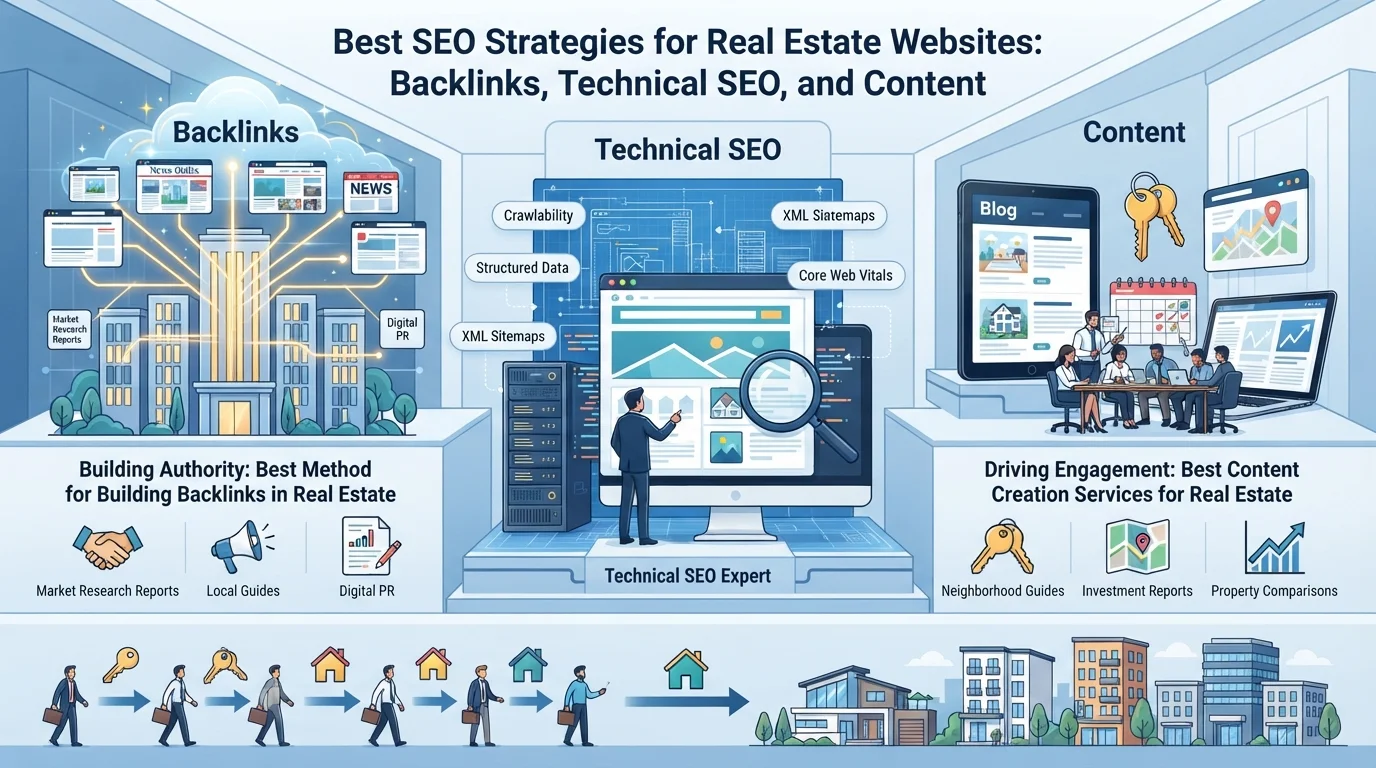
Because of this complexity, a successful real estate SEO strategy needs to combine three major areas:
- High-quality backlinks from relevant and authoritative websites.
- Strong technical SEO that allows search engines to efficiently crawl, understand, and index the website.
- Useful, original content that answers real estate questions and earns visibility, engagement, and references.
These elements are interconnected. Great content can attract backlinks, technical SEO can help search engines discover and understand that content, and authoritative backlinks can strengthen the overall credibility of the website.
The goal should not simply be to obtain as many backlinks as possible or publish thousands of pages. The objective is to build a website that deserves to be visible because it provides useful information, a strong user experience, trustworthy property data, and valuable resources.
read more about new home checklist
Why Real Estate SEO Requires an Industry-Specific Approach
Real estate websites operate within a highly competitive search environment. Multiple businesses may target the same locations and keywords, including national property portals, local agencies, independent brokers, developers, investment companies, property management businesses, and specialized real estate publications.
A real estate agency competing for searches related to a city or neighborhood may therefore face established websites with years of accumulated authority and thousands of indexed pages.
Simply adding the same property descriptions used across other websites is unlikely to create a strong competitive advantage. Real estate businesses need assets that other websites have a reason to reference.
These assets can include original housing market research, local price reports, neighborhood guides, investment studies, development updates, property comparisons, buyer resources, mortgage explanations, rental market analysis, and useful location-specific information.
The combination of technical quality, authoritative backlinks, and valuable content creates a sustainable foundation for real estate search visibility.
Understanding the Best Method for Building Backlinks for Real Estate Websites
Why Backlink Quality Matters More Than Quantity
The best method for building backlinks is not to collect the largest possible number of links. It is to create valuable resources and relationships that generate relevant, trustworthy references from websites that make sense within the real estate industry.
A backlink from a respected real estate publication, local business organization, property research platform, university, financial publication, architecture website, local news outlet, or established industry resource can be considerably more meaningful than dozens of unrelated links from low-quality websites.
This is because search engines evaluate links within a broader context. Relevance, authority, editorial placement, the credibility of the referring website, and the usefulness of the referenced content all contribute to the value of a link.
For a real estate business, a backlink from a website discussing housing trends in the same city may be much more appropriate than a link from an unrelated general website.
The central principle is simple: build things worth referencing.
What Makes a Real Estate Backlink Valuable?
Several factors should be considered when evaluating a potential backlink.
Topical Relevance
A link from a website related to property, housing, construction, architecture, finance, investment, local business, or a specific geographic market is generally more contextually appropriate than a link from an unrelated website.
For example, a local housing report referenced by a respected property publication has a clear relationship between the source and destination.
Authority and Trust
The referring website should have a legitimate audience, credible content, and a meaningful presence in its industry or geographic market.
A website does not need to be globally famous to provide value. A respected local newspaper or regional property publication can be highly relevant to a real estate agency operating in that market.
Editorial Context
Naturally earned editorial links are especially useful because they occur within content where the destination resource genuinely adds value.
A journalist might reference a real estate market report when discussing rising property prices. A local publication might reference a neighborhood guide when covering a developing district. An investment publication might cite rental yield data from a property research report.
These links are more meaningful than links placed on pages created primarily for selling or exchanging backlinks.
Link Placement
Context matters. A backlink incorporated naturally into an informative article can provide stronger relevance than a link buried in a generic directory or unrelated page.
The surrounding content should help explain why the linked resource is useful.
Traffic Potential
A backlink can have value beyond SEO. If the referring website has an audience that includes potential buyers, sellers, investors, landlords, or tenants, the link can generate qualified referral traffic.
For a real estate business, this can be particularly important. A relevant link that sends 100 interested investors may be more commercially useful than hundreds of links that produce no relevant visitors.
Publishing Original Real Estate Market Research
Why Original Data Attracts Links
One of the most effective link-building strategies for real estate websites is producing original research.
Real estate journalists, bloggers, analysts, investors, property professionals, and local organizations frequently need reliable statistics. If a company produces useful data that cannot easily be found elsewhere, other websites have a reason to reference it.
Examples include:
- Average property prices by neighborhood.
- Rental price trends.
- Changes in rental yields.
- Property transaction trends.
- Supply and demand patterns.
- Average time properties remain on the market.
- Price differences between property types.
- New development activity.
- Buyer preferences.
- Investor preferences.
- Changes in asking prices.
- Local housing affordability.
- Property price changes over multiple years.
The strongest research does not simply publish numbers. It explains what those numbers mean.
Turning Internal Data Into Linkable Assets
A real estate company may already have valuable information within its CRM, property database, sales records, market observations, or research department.
For example, an agency could analyze thousands of listings to identify changes in asking prices across different neighborhoods.
Instead of keeping this information internally, the company could transform it into a public report.
A useful report might include:
- Methodology.
- Data collection period.
- Geographic coverage.
- Property categories.
- Average asking prices.
- Median prices.
- Year-over-year changes.
- Rental trends.
- Neighborhood comparisons.
- Key observations.
- Charts and tables.
- Expert interpretation.
Journalists and industry websites can then use the findings as a source.
Updating Market Research Regularly
A single report can become even more valuable when it develops into a recurring publication.
For example, a real estate website could publish a quarterly housing market report covering the same locations and metrics.
Over time, this creates an archive of original research. Journalists looking for historical data may reference older reports, while current publications can reference the latest edition.
This approach can also generate internal linking opportunities and establish the business as a source of market information.
Creating Local Property and Neighborhood Guides
Why Local Content Is Powerful for Real Estate SEO
Real estate decisions are inherently geographic.
People rarely search for property information without considering location. They want to know about neighborhoods, transportation, schools, amenities, employment centers, shopping areas, development projects, rental markets, and lifestyle factors.
This makes local resources particularly valuable for real estate websites.
A comprehensive neighborhood guide could explain:
- Property types available.
- Typical property prices.
- Rental costs.
- Transportation options.
- Major roads.
- Public transport.
- Schools and educational facilities.
- Healthcare services.
- Shopping areas.
- Restaurants and entertainment.
- Parks and recreational facilities.
- New developments.
- Investment considerations.
- Typical residents.
- Rental demand.
- Advantages and limitations of the area.
The goal should be to provide information that is genuinely useful rather than creating a thin page simply to target a location keyword.
Building Neighborhood Resource Hubs
Large real estate websites can organize local content into geographic hubs.
A city page can connect to district pages. District pages can connect to neighborhood guides. Neighborhood guides can connect to relevant property listings, market reports, investment resources, and buyer guides.
This creates a logical information architecture.
It also helps users move naturally from broad research to specific property searches.
For example, someone searching for information about a city may discover a neighborhood guide. After learning about the area, they can explore available apartments, houses, commercial properties, rental opportunities, or new developments.
This approach connects informational and transactional search intent.
read more about increase property value
Developing Investment Reports for Real Estate Audiences
Targeting Property Investors
Investors have different information needs from ordinary buyers.
They may search for:
- Rental yield.
- Capital appreciation.
- Rental demand.
- Vacancy rates.
- Property prices.
- Development activity.
- Infrastructure investment.
- Population growth.
- Employment trends.
- New transport projects.
- Neighborhood comparisons.
- Investment risks.
Real estate websites can attract this audience by creating detailed investment reports.
For example, a report could compare several neighborhoods based on average purchase prices, rental costs, estimated gross yields, property supply, development activity, and long-term market indicators.
Making Investment Content Credible
Investment content should be careful about distinguishing factual information from opinion.
A strong report should explain its methodology and clearly identify assumptions. If estimated rental yields are used, the calculation should be explained.
Avoid presenting speculative forecasts as guaranteed outcomes.
Real estate SEO should build trust, not exaggerate potential returns.
A transparent approach can also make the content more useful to journalists and industry professionals, increasing its chances of being referenced.
Using Expert Commentary as a Link-Building Strategy
Becoming a Source for Journalists
Real estate professionals have access to industry knowledge that journalists often need.
A broker may understand local buyer behavior. A developer may understand construction trends. A property manager may know what tenants are demanding. An investment specialist may have insight into rental markets.
Companies can use this expertise to contribute commentary to relevant publications.
For example, a journalist writing about rising housing prices might need an expert explanation of why demand has increased.
A real estate professional who provides clear, evidence-based commentary may receive attribution and potentially a link to the company’s website.
Creating a Strong Expert Profile
Companies should make it easy for journalists to identify knowledgeable experts.
An expert profile can include:
- Professional background.
- Area of specialization.
- Geographic expertise.
- Industry experience.
- Relevant research.
- Contact information for media inquiries.
- Previous commentary.
- Published reports.
This transforms expertise into a potential digital PR asset.
Digital PR for Real Estate Websites
Creating Stories That Publications Want to Cover
Digital PR works best when a company has something genuinely interesting to communicate.
Instead of sending generic promotional announcements, real estate businesses can develop stories based on data, trends, unusual market observations, development changes, consumer behavior, or local research.
Potential stories include:
- The fastest-growing neighborhoods.
- Areas experiencing major rental demand.
- Changes in apartment sizes.
- Emerging investment locations.
- Differences between rental and purchase markets.
- Property features buyers increasingly request.
- Changes in buyer preferences.
- New infrastructure affecting property markets.
- Housing affordability trends.
- Regional differences in property prices.
A compelling story gives journalists a reason to reference the business or its research.
Data-Driven PR
Data can make PR campaigns significantly more useful.
Suppose a real estate company analyzes 20,000 property listings and identifies a major change in buyer demand.
The company could publish the methodology and findings, create visualizations, provide expert commentary, and offer the research to journalists.
This creates several potential link opportunities:
- News articles.
- Industry publications.
- Market analysis websites.
- Local newspapers.
- Investment publications.
- Business blogs.
- Academic or research discussions.
The strongest PR campaigns are built around useful information rather than promotional claims.
Building Partnerships With Relevant Organizations
Local Partnerships
Real estate businesses naturally interact with many organizations.
Potential relationships include:
- Architects.
- Interior designers.
- Mortgage companies.
- Property lawyers.
- Surveyors.
- Construction firms.
- Home improvement businesses.
- Relocation services.
- Universities.
- Local business groups.
- Chambers of commerce.
- Community organizations.
- Property associations.
Some partnerships may create legitimate opportunities for useful references.
For example, a real estate agency might collaborate with an architecture firm to publish a guide about sustainable residential design.
A developer could collaborate with a local organization to publish a community development resource.
The partnership should provide real value rather than existing solely for exchanging links.
Industry Associations
Membership in legitimate professional organizations can also create opportunities for visibility.
Industry associations may publish member profiles, research, event announcements, expert contributions, or educational resources.
Businesses should focus on genuine participation rather than joining organizations purely for backlinks.
Creating Useful Property Content That Naturally Earns References
Buyer Guides
One of the strongest content categories for real estate websites is the practical buyer guide.
Potential topics include:
- How to evaluate a property before buying.
- Questions to ask during a property viewing.
- How to compare properties.
- Costs associated with purchasing a property.
- How to evaluate a neighborhood.
- How to compare new developments.
- What to inspect before making an offer.
- How to prepare for a property viewing.
- Common property buying mistakes.
- How to evaluate long-term resale potential.
These resources can attract links because other websites can reference them when discussing the buying process.
Seller Resources
Real estate websites should not focus exclusively on buyers.
Seller-focused resources can address:
- Preparing a property for sale.
- Pricing considerations.
- Property photography.
- Viewing preparation.
- Common selling mistakes.
- Understanding market conditions.
- Comparing agency services.
- Preparing documentation.
- Responding to buyer offers.
These topics can attract homeowners researching how to sell their properties.
Tenant and Rental Resources
Rental content can attract a separate audience.
Useful topics include:
- How to compare rental properties.
- Questions tenants should ask.
- Understanding rental agreements.
- Preparing for a property viewing.
- Evaluating rental costs.
- Moving checklists.
- Neighborhood rental comparisons.
- Apartment maintenance responsibilities.
A comprehensive rental resource can become a reference point for tenants and housing publications.
The Role of a Technical SEO Expert in Real Estate
Why Technical SEO Becomes Critical at Scale
A small business website may contain a few dozen pages. A real estate portal can contain hundreds of thousands or millions of URLs.
Every property listing can generate a unique URL. Additional URLs may be created through:
- Property types.
- Locations.
- Price filters.
- Bedroom filters.
- Amenities.
- Sorting options.
- Map searches.
- Availability filters.
- Rental periods.
- Search combinations.
Without careful technical controls, search engines may spend significant resources crawling low-value or duplicate URLs.
This is why a technical SEO expert can play an important role in large real estate websites.
Crawlability
Search engines need to discover important pages efficiently.
A technical seo expertcan examine:
- Internal links.
- XML sitemaps.
- Robots directives.
- Redirects.
- Status codes.
- Crawl paths.
- JavaScript rendering.
- Orphan pages.
- Crawl depth.
The goal is not to make every URL indexable.
Instead, the website should help search engines prioritize valuable pages.
For example, important location pages and unique property pages may deserve strong internal linking, while temporary filter combinations may not need to be crawled or indexed.
Indexing Management for Property Websites
Avoiding Indexation of Low-Value URLs
Real estate websites can accidentally create huge numbers of low-value URLs.
Consider a property search page that allows users to filter by:
- Price.
- Bedrooms.
- Bathrooms.
- Property type.
- Furnishing.
- Amenities.
- Location.
- Availability.
- Sort order.
If every combination creates a crawlable URL, the website could produce thousands of variations that provide little unique value.
A technical SEO expert should determine which combinations represent meaningful search demand and which should remain outside the search engine index.
Managing Indexable Pages Strategically
Indexation should support the business’s actual search strategy.
High-value pages may include:
- Major city pages.
- Important neighborhood pages.
- Property category pages.
- High-quality development pages.
- Unique property listings.
- Investment guides.
- Market reports.
Low-value or temporary pages may include:
- Internal search states.
- Duplicate filter combinations.
- Sorting variations.
- Empty result pages.
- Tracking parameters.
Technical SEO helps establish clear rules for these different URL types.
read more about home buying mistakes
URL Structure for Real Estate Websites
Creating Logical URLs
A real estate website benefits from a clear and predictable URL structure.
URLs should communicate page purpose and location where appropriate.
For example, the architecture might distinguish between:
- Cities.
- Neighborhoods.
- Property types.
- Individual listings.
- Developments.
- Guides.
- Market reports.
A logical structure helps users understand where they are and can also make crawling and site management easier.
Avoiding Unnecessary URL Variations
A property listing should not generate multiple URLs for the same content because of tracking parameters, sorting settings, session information, or alternative navigation paths.
When duplicate URLs are unavoidable, canonicalization and other technical controls can help search engines identify the preferred version.
Duplicate Property Listings
Why Duplicate Listings Create Problems
Real estate portals often publish the same or very similar property across multiple pages.
A property may appear through:
- An agency page.
- A location page.
- A property type page.
- A filtered search.
- A development page.
- A syndicated listing.
- A partner feed.
If search engines encounter multiple URLs containing essentially the same information, it can become difficult to determine which page should be prioritized.
Handling Duplicate Content
Technical solutions may include:
- Canonical tags.
- Consistent internal linking.
- Appropriate redirects.
- Controlled URL parameters.
- Unique property descriptions where practical.
- Clear primary listing URLs.
The correct solution depends on the website architecture.
A technical SEO expert should analyze the actual URL system rather than applying one universal rule.
Canonical Tags and Real Estate SEO
Choosing the Preferred Version
Canonical tags can help communicate which version of a page should be considered the primary URL when duplicate or highly similar pages exist.
This can be especially useful for large property websites with multiple pathways to the same listing or category.
However, canonical tags should not be treated as a solution for every technical problem.
They need to be consistent with internal links, XML sitemaps, redirects, and the overall site architecture.
Canonicalization Requires Ongoing Monitoring
Real estate websites change frequently.
Listings are added, removed, updated, syndicated, and reorganized.
A technical SEO process should therefore monitor canonical implementation continuously rather than treating it as a one-time configuration.
Faceted Navigation and Property Filters
The SEO Challenge of Filters
Faceted navigation is extremely useful for users because it allows them to narrow property searches.
However, from an SEO perspective, it can create a massive number of URLs.
For example, a user might filter properties by:
- Two bedrooms.
- Under a specific price.
- Furnished.
- With parking.
- In a specific neighborhood.
- With a swimming pool.
Each combination could generate a unique URL.
Not every combination deserves to appear in search engines.
Turning Valuable Filters Into SEO Landing Pages
Some filter combinations may represent substantial search demand.
For example, a real estate business may decide that dedicated landing pages for certain property types and neighborhoods provide real user value.
Those pages can be intentionally optimized with unique content, useful property inventory, internal links, and relevant metadata.
This is very different from allowing every possible filter combination to become indexable.
The distinction between intentional SEO landing pages and automatically generated search URLs is crucial.
Internal Linking Across Real Estate Websites
Connecting Content With Property Inventory
Internal linking helps users and search engines discover related pages.
A neighborhood guide can link to available properties in that neighborhood.
A buyer guide can link to relevant property categories.
A market report can link to neighborhood pages.
An investment guide can link to development pages and property listings.
This creates a connected ecosystem.
Building Topic and Location Hubs
A real estate website can organize internal links around both topics and locations.
For example:
A city hub can connect to neighborhood pages.
A neighborhood page can connect to property listings, rental pages, investment guides, and market reports.
An investment guide can connect to relevant market data.
This architecture makes it easier for users to continue their research while helping search engines understand relationships between pages.
Structured Data for Property Websites
Helping Search Engines Understand Page Information
Structured data can help communicate information about page entities and content in a standardized format.
Depending on the page and eligibility, real estate websites may use appropriate structured data for relevant content types.
Potentially useful information can include:
- Property details.
- Organization information.
- Breadcrumbs.
- Local business information.
- Events.
- Articles.
- FAQs where applicable.
Structured data should accurately represent visible page content and comply with search engine guidelines.
It should not be used to manipulate search results by marking up information that users cannot actually see.
Core Web Vitals and Real Estate Websites
Why Performance Matters
Real estate websites are often image-heavy.
A typical property listing may contain:
- Multiple high-resolution photographs.
- Floor plans.
- Maps.
- Video.
- Virtual tours.
- Interactive search tools.
These features can create significant performance challenges, especially on mobile devices.
A technical SEO expert should therefore monitor page performance and Core Web Vitals.
Improving Property Image Performance
Image optimization can have a major effect on property websites.
Practical improvements include:
- Compressing images.
- Using modern image formats where appropriate.
- Serving responsive image sizes.
- Avoiding unnecessarily large images.
- Lazy-loading below-the-fold images.
- Prioritizing important visible images.
- Optimizing image delivery infrastructure.
The goal is to preserve visual quality while reducing unnecessary page weight.
Mobile Performance
Many property searches happen on mobile devices.
A property website should therefore provide a fast and usable mobile experience.
Important considerations include:
- Responsive layouts.
- Easy-to-use filters.
- Readable property information.
- Fast image loading.
- Accessible contact buttons.
- Simple inquiry forms.
- Stable page layouts.
- Efficient map functionality.
SEO and conversion optimization overlap significantly here. A better mobile experience can help users complete the actions the business actually wants them to take.
Handling Expired and Unavailable Property Pages
Why Deleted Listings Can Create SEO Problems
Property inventory changes constantly.
A listing can become unavailable because:
- The property was sold.
- The property was rented.
- The owner withdrew it.
- The listing expired.
- The development was completed.
- The agency stopped representing the property.
Simply deleting every unavailable listing can create broken links and remove potentially valuable pages.
Deciding What to Do With Expired Listings
The correct approach depends on the circumstances.
If a page has no ongoing value and no relevant replacement exists, returning an appropriate status may be reasonable.
If the property has been replaced by another listing or development page, a relevant redirect may make sense.
If historical information remains valuable, the page may potentially be transformed into a useful archived resource, provided this serves users and fits the site’s strategy.
The key is to avoid automatically redirecting every expired listing to a generic homepage.
An irrelevant redirect may provide a poor user experience and fail to preserve the original page’s context.
Content Strategy and the Role of Best Content Creation Services
Why best content creation services are Essential for Real Estate SEO
Property listings alone may not provide enough informational depth to attract users at every stage of the search journey.
A person may not begin with a specific property.
They may begin with a question:
“Which neighborhood is best for families?”
“Is this area good for rental investment?”
“What is the average apartment price?”
“How much rent can I expect?”
“What should I check before buying?”
“What are the differences between these neighborhoods?”
Content allows a real estate website to answer these questions before the user is ready to browse listings.
Creating Content Around Search Intent
A strong real estate content strategy should map content to different types of search intent.
Informational intent includes searches for explanations, guides, definitions, and market information.
Commercial investigation includes comparisons, neighborhood evaluations, property type comparisons, and investment research.
Transactional intent includes searches for available properties, developments, rentals, and purchase opportunities.
Navigational intent involves users looking for a specific agency, development, location, or property.
A complete SEO strategy should serve all of these stages.
Buying Guides and Property Comparisons
Helping Users Make Better Decisions
Buying guides can target users who are actively considering a purchase.
A comprehensive guide could explain the differences between:
- Apartments and villas.
- New builds and existing properties.
- Central and suburban neighborhoods.
- Freehold and leasehold options where relevant.
- Ready properties and off-plan developments.
- Investment properties and owner-occupied homes.
Comparison content is particularly useful because it helps users evaluate options.
Creating Evidence-Based Comparisons
Real estate comparisons should be based on clear criteria.
For example, a neighborhood comparison might consider:
- Average property prices.
- Rental costs.
- Transportation.
- Amenities.
- Property supply.
- Development activity.
- Buyer demographics.
- Rental demand.
Avoid presenting subjective preferences as universal facts.
A transparent comparison is more useful to readers and more credible as a reference.
Neighborhood Pages as Long-Term SEO Assets
Building Pages That Offer More Than Property Listings
A neighborhood page should not consist of a list of properties followed by generic introductory text.
A strong page can include:
- Overview.
- Property market information.
- Housing types.
- Price trends.
- Rental information.
- Transportation.
- Amenities.
- Schools.
- Healthcare.
- Lifestyle information.
- Development activity.
- Investment considerations.
- Frequently asked questions.
- Current property listings.
This creates a resource with standalone value.
Keeping Location Pages Current
Local conditions change.
New developments open. Transportation networks evolve. Prices move. Amenities change. Rental demand fluctuates.
Real estate websites should therefore establish a process for reviewing important location pages.
Freshness should not mean changing text randomly. It should mean updating factual information when meaningful changes occur.
Market Trends Content
Turning Market Changes Into Search Opportunities
Real estate markets generate continuous questions.
Users may want to understand:
- Whether prices are rising.
- Where demand is strongest.
- Which property types are popular.
- How rental prices are changing.
- Which neighborhoods are developing.
- How interest rates may affect purchasing decisions.
- How supply is changing.
A real estate website can create recurring content around these themes.
Avoiding Sensationalism
Market content should avoid exaggerated claims.
Statements such as “prices will definitely double” or “this neighborhood is guaranteed to become the next investment hotspot” can undermine credibility.
Instead, explain observable trends, available evidence, limitations, and potential scenarios.
This approach is more professional and more useful to serious buyers and investors.
FAQs and Practical Property Resources
Answering Real Questions
FAQ content can help address common questions that appear throughout the property journey.
Examples include:
- How do I prepare for a property viewing?
- What documents should I review?
- What questions should I ask an agent?
- How can I compare rental properties?
- What factors affect property value?
- What should investors examine before buying?
- How can I evaluate a neighborhood?
- What should I consider when renting a property?
The best FAQs should be based on actual customer questions rather than generated simply to insert keywords.
Building Comprehensive Resource Centers
Instead of publishing isolated articles, real estate websites can build resource centers organized around user needs.
A buyer resource center might contain:
- Buying guides.
- Property checklists.
- Neighborhood comparisons.
- Financing information.
- Viewing guides.
- Market reports.
A seller resource center could contain:
- Valuation guidance.
- Preparation advice.
- Selling checklists.
- Market reports.
- Pricing information.
This structure creates stronger topical depth.
read more about family home buying guide
How Backlinks, Technical SEO, and Content Work Together
Content Creates Reasons to Earn Links
Backlinks are much easier to earn when a website contains something worth referencing.
A generic property listing rarely gives a journalist a strong reason to link.
A detailed housing market report does.
A comprehensive neighborhood guide does.
Original research does.
A useful property comparison does.
An interactive market resource does.
Therefore, content can serve as the foundation of a link acquisition strategy.
Technical SEO Makes Content Discoverable
Even excellent content can struggle if search engines cannot efficiently access, understand, and index it.
Technical SEO helps ensure:
- Important pages can be crawled.
- Preferred URLs are clear.
- Duplicate pages are controlled.
- Internal links connect related resources.
- Structured data is implemented appropriately.
- Mobile performance is strong.
- Broken pages are managed.
- XML sitemaps reflect important URLs.
This creates the technical environment required for content to perform effectively.
Backlinks Reinforce Authority
When authoritative and relevant websites reference useful real estate resources, those links can contribute to the site’s overall authority.
This can help the website compete for more difficult search topics.
The relationship can therefore be summarized as:
Content creates value.
Technical SEO makes that value accessible.
Backlinks provide external recognition.
Together, these elements create a stronger SEO ecosystem.
Building a Real Estate Backlink Campaign Step by Step
Step One: Audit Existing Backlinks
Before building new links, understand the current backlink profile.
Look for:
- Relevant referring domains.
- Industry publications.
- Local websites.
- Existing media coverage.
- Broken backlinks.
- Lost backlinks.
- Unlinked brand mentions.
- Low-quality patterns.
- Competitor link opportunities.
The purpose is not to obsess over a single backlink metric.
Instead, identify what the website already has and where meaningful opportunities exist.
Step Two: Identify Linkable Assets
Review existing website content and determine which pages are genuinely useful enough to attract references.
Potential assets include:
- Research reports.
- Statistics.
- Market dashboards.
- Neighborhood guides.
- Investment reports.
- Property calculators.
- Original studies.
- Comprehensive buying guides.
- Local housing resources.
If there are no strong linkable assets, content development should come before aggressive outreach.
Step Three: Research Relevant Publishers
Build a list of publications and organizations that cover:
- Real estate.
- Property investment.
- Housing.
- Architecture.
- Construction.
- Local business.
- Finance.
- Urban development.
- Lifestyle.
- Local communities.
Prioritize relevance over the size of the list.
Step Four: Create a Useful Outreach Angle
Outreach should explain why the resource is relevant.
A journalist covering housing prices may be interested in original market data.
A neighborhood publication may be interested in local housing trends.
An investment publication may be interested in rental yield research.
The pitch should focus on the information rather than simply asking for a backlink.
Step Five: Promote Through Genuine Relationships
Long-term relationships can outperform one-time outreach.
Real estate businesses can build relationships by:
- Providing expert commentary.
- Sharing useful data.
- Participating in industry discussions.
- Contributing educational material.
- Collaborating on research.
- Supporting relevant local initiatives.
These activities can naturally lead to references.
Common Real Estate Link-Building Mistakes
Buying Large Numbers of Low-Quality Links
One of the most common mistakes is treating backlinks as a commodity.
Purchasing large quantities of links from unrelated websites may create an artificial-looking backlink profile and does not create genuine authority.
More links do not automatically mean better SEO.
Using Exact-Match Anchor Text Excessively
Another mistake is attempting to control every backlink’s anchor text.
Natural backlink profiles typically contain varied references.
Some links may use a brand name. Others may use a page title, location name, generic language, or natural descriptive wording.
The focus should be earning genuine references rather than manipulating every anchor.
Publishing Generic Guest Posts at Scale
Guest contributions can be useful when they provide genuine value and are relevant to the publication.
However, producing large volumes of thin articles solely to acquire links can become counterproductive.
A better approach is to contribute unique expertise to reputable publications where the content makes sense for their audience.
Creating Thin Location Pages
Real estate websites sometimes create hundreds of city or neighborhood pages with minimal differences.
A location page should exist because users need the information.
If there is no meaningful local content, simply replacing the location name in a template does not create a useful resource.
Ignoring Existing Technical Problems
Building backlinks to a website with serious technical problems can limit the value of the investment.
If important pages are not indexed, duplicate URLs dominate the site, internal links are weak, or property pages frequently return errors, the technical foundation should be addressed.
Measuring the Success of Real Estate SEO
Organic Visibility
Monitor whether the website is gaining visibility for relevant searches.
The focus should be on meaningful topics related to:
- Locations.
- Property types.
- Buyer questions.
- Investment research.
- Rental searches.
- Market trends.
- Neighborhood information.
Ranking for irrelevant keywords does not necessarily create business value.
Qualified Organic Traffic
Traffic should be evaluated based on quality.
A thousand visitors searching for unrelated information may be less valuable than a hundred visitors actively researching properties in the company’s target market.
Useful indicators can include:
- Property views.
- Inquiry submissions.
- Viewing requests.
- Phone calls.
- Registration.
- Saved properties.
- Brochure downloads.
- Investment report engagement.
Backlink Quality
Track the quality and relevance of newly acquired referring domains.
Questions to consider include:
- Is the referring website relevant?
- Does it have a real audience?
- Is the link editorially appropriate?
- Does it generate referral traffic?
- Is the content surrounding the link relevant?
This provides a more useful perspective than simply counting backlinks.
Content Performance
Evaluate whether content attracts:
- Organic traffic.
- Backlinks.
- Engagement.
- Internal clicks.
- Property discovery.
- Assisted conversions.
Some articles may not convert directly but can still introduce users to the brand earlier in their research journey.
Creating a Sustainable Real Estate SEO Workflow
Monthly Technical Monitoring
Large property websites should continuously monitor technical health.
Important checks can include:
- Indexation changes.
- Crawl errors.
- Broken links.
- Redirect chains.
- Canonical issues.
- Sitemap problems.
- Duplicate pages.
- Page speed.
- Mobile performance.
- Expired listings.
- Internal linking.
Regular Content Development
Content should follow a defined editorial strategy rather than being published randomly.
A monthly calendar might include:
- One market analysis.
- Two neighborhood resources.
- Two buyer guides.
- One investment article.
- One property comparison.
- One local trend report.
- Supporting FAQ content.
The exact frequency should depend on resources and quality standards.
Ongoing Digital PR
PR should not only happen when a company launches a new development.
Market research, expert insights, local data, industry commentary, and consumer trends can create year-round opportunities.
This makes link acquisition part of the company’s broader communication strategy.
read more about ready property vs off plan
A Practical Strategy for Real Estate Agencies
Focus on the Local Market
A local agency does not need to compete with a national property portal on every possible keyword.
It can build authority around its strongest geographic market.
This may involve creating comprehensive resources for specific neighborhoods and cities.
Become the Local Information Source
An agency can differentiate itself by publishing information that demonstrates genuine local knowledge.
For example:
- Neighborhood price reports.
- Rental market updates.
- Local development news.
- Buyer guides.
- School and amenities resources.
- Investment comparisons.
- Local property trends.
This creates reasons for local publishers and community websites to reference the agency.